Temporal Proprioception
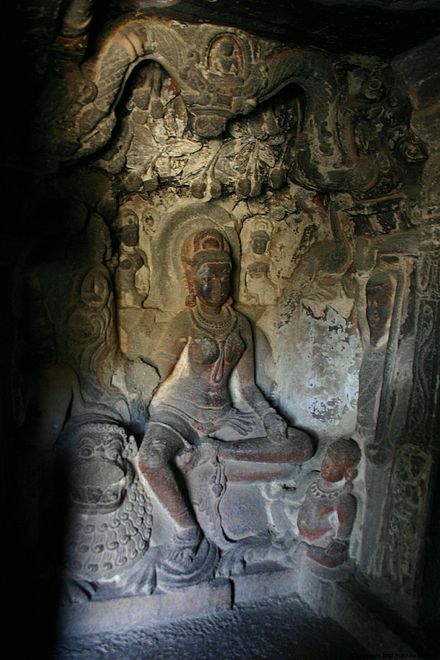
Sculpture identified as Ambika in the Ellora caves
“Illusion does not mean the illusion of perception, but the false conclusion based on perception.”
Yuganaddha (1969), H. V. Guenther, p. 64
From Severed Rose:
Now I understand that death is not due to me for knowing the Devi’s name, but total readiness to die comes with acknowledgement of her life-sustaining magic. So there she is, the witch on the roof, the one who severed the rose: Kali Ma, infernal mother who destroys all illusions, including the illusion of compassion.
Ambika, thou art the dreaming power of Eternity,
The seed spiral wrapping of the Universe,
And the supreme apparition of Maya.
All the universe is bewitched by thee,
But thou, when it pleases you, are the cause of our liberation.– Hymns to Kali, 11th Mahatmya of Chandi
From Severed Rose, Part III, Infinity Ridge
Ambika is one of the 1001 names of Kali. Suggesting that there are 1001 ways to try to figure out how her magic works.
The Walking Stick
Elsewhere, I have proposed that we do not normally have the ability to use innate paranormal capacities (“siddhis”) due the power of attention being exhausted, like a battery with limited power, in maintaining proprioception. Defined as:
Proprioception, also called kinesthesia, is the reason we’re able to move freely without consciously thinking about our environment. Examples of proprioception include being able to walk or kick without looking at your feet or being able touch your nose with your eyes closed. Some things can affect proprioception. Temporary impairment can come from drinking too much alcohol, which is why a sobriety test involves touching your nose while standing on one foot. Injuries or medical conditions that affect the muscles, nerves, and the brain can cause long-term or permanent proprioception impairment. Age-related changes also affect proprioception.
You can also compare proprioception to a peripheral plugged into one of those infernal devices called a dock or dongle. It has input slots for USB drives, monitor, printer, etc. However, if the dock is not provided with sufficient power — some models come with AC connecting — there is not enough electricity running in the mainframe of the computer to support the peripherals. Thus, USB thumb drives don’t work, etc. The faculties provided by cosmic projection to function normally in D 4 are peripherals. The power that runs the mainframe is inherent to rigpa, observation. Thus, we can observe the “special effects” of the Parinama but without a higher concentration of rigpa we cannot detect the installations in the CPU, the central processing unit,”Intel Inside.”
This routine definition cited above emphasizes that proprioception is spatial. It is motoric and kinetic. But what if it is also temporal? I have compared proprioception to a blind man’s walking stick with the features of a pogo stick, hence, elastic properties. When you scan a crowd of people, your rigpa has a palpable tension that changes when you recognize someone you know in the crowd. The proprioception of time has similar variations, more subtle and almost impossible to detect.
For instance, when you reflect on recent memories, the pogo-stick tension is high, compressed. In contrast to reflecting on remote moments in time, even exceeding your own lifeline, when the tension is weaker as it is in the pogo-stick when extended to its complete length so that the spring mechanism has no torque left in the coil. Due to the predicted shortening of human attention span at the end of Kali Yuga, the vast majority of people have only short extension of memory. The torque of the coil has a minimal range of expansion and recoil.
You do not have to remember that you existed before to remember that you exist now, in the present moment. Memory of existing in the present moment is the neutral or default setting of the pogo-stick, “at rest” before it expands and rebounds. Let’s call memory of existing in the present moment the temporal reset of the awareness of living in linear time. Ambika is that aspect of Kali’s time magic that continuously restores and supports the reset to the passing moment. Ambika “refreshes” consciousness. Memory of existing in the exact moment is the refresh function of rigpa in temporal proprioception (TP). Although the myriad ramifications of the magic of nine internesting fractal dimensions of time are baffling and largely beyond human conception, the phenomenon of TP stands well within reach and can easily be investigated. It’s more than obvious.
An Hilarious Moment
In amnesia, you momentarily forget how you came to be where you are as well as the timing of being there. Nevertheless, you can look around and move and function. Temporal reset (TR) persists in the absence of memory of the past. For instance, I can forget how I got to be here in the house in Galicia on this particular day, and even forget what day it is, but I can still function in the house at this moment, typing these words.
I distinguish moderate and deep amnesia. In moderate or approximate amnesia, I don’t forget what things are, such as the hallway, stairs, kitchen, fridge. I know that the fork is a fork and how to use it. In deep amnesia I do not even know what the fork is, or a chair is, etc. But even in that state — which I experienced in August 2008 with Jeanne, the Shakti OTM — I could still stand at the fridge and open it. The condition attendant to deep amnesia is called aphasia, the incapacity to remember the names of things which define their functions.
The term hilaria occurs in ancient evidence of the Mysteries, with allusion to a rite of celebration. From NIHI: “One initiate to the cult of Attis, a man named Damascius, left this account: “I imagined that I had become Attis, and that I was being initiated by the Mother of the Gods in the festival called Hilaria, inasmuch as it was intended to signify that our release from death had been accomplished”(n. 147). I can attest that standing at the fridge at that moment was hilarious. We were both laughing hysterically as we phased out of the experience, for a good half hour. It is significant, no doubt, that the testimony states how “our release from death had been accomplished.”
When you have the TR, it refreshes your awareness of existing in the singular passing moment. It gives you the distinct experience of instantaneity, yet it is overshadowed by ordinary memory — by what I call the lookback effect. Although I do not need to remember that I existed previously to this moment, the lookback effect reminds me of “the past” and overrides the refreshing effect of the temporal reset which is totally independent of the temporal proprioception of linear time (TP).
TP persistently overrides the refresh action of TR. You can prove that is true simply by observing it in action. Temporal proprioception draws the force of your attention to past and future frames. The more it does so, the less attention you have for the miraculous function of Temporal Reset.
ME, Now and Then
Then and now, now and then
Makes you wonder when is when
However, there is a simple exercise for separating these two features. In other words, you can artificially induce the condition of amnesia that reduces or eliminates the lookback effect. Here is how it goes:
Conceive the difference between ME-THEN and ME-NOW. ME-NOW is the given presence in space and time, where you actually are here and now. ME-THEN is an exact previous moment you can isolate in memory. The exercise works better if you select a precise moment and setting in vivid detail for ME-THEN. That would be a moment with a distinct key signature of emotional intensity combined with a clear and complete “holographic” memory.For example, I can place ME-THEN, which is me at a past moment, in the kitchen of the house in Gaucin on a Friday when I fed gambas to Nikita who sits on the table. I go to that event and revive it vividly. I picture myself seen from a specific angle as if setting up a shot in a film being recorded. I behold myself, ME-THEN, at that moment feeding gambas to Nikita.
Next, I picture ME-THEN as I was in that time and setting with me looking away from the table to the kitchen window and in the frame of the kitchen window. In that frame of that scene for ME-THEN, I see the ME-NOW. ME-THEN looks ahead in time using the faculty of temporal proprioception on an extended coil (“seed spiral wrapping”). Next, I transport the ME-THEN ahead to the time and setting of the ME-NOW. The effect of this exercise in transposition brings the ME-THEN into the position of a co-present observer with the ME-NOW. As if the ME-NOW has a second, invisible head observing what is happening. A co-present phantom double.
Holding steady in the exercise, I imagine that the ME-THEN looks around as if the YOU-NOW is in a state of amnesia with no lookback effect. Of course, the ME-NOW recognizes everything in the time and setting. He knows where he is and when and how he got there. The ME-THEN observing from the past knows nothing of all that, of course. It has no memory of the nine years transpiring between the two events. Continuing, the ME–THEN looks at what is there now pretending not to recognize what it sees. In this way, I attempt to override the lookback effect of recall held by the ME-NOW.
I cannot literally override it, of course. But I can engender the sense of overriding it. I can induce a quasi-amnesiac state even though the ME-NOW remembers what is to the ME-THEN a linear sequence extending into the future. Amnesiac centering happens when you remember that you exist in the present moment without reference to memory of the past. You experience amnesiac centering continuously: it is the awareness of existing in the present moment absent of any reference to the past, absent of the lookback effect. But you are not vividly and distinctly struck by not needing to recall the past to register the present. Why not? Obviously, because the recall of the past is continually there due to the lookback effect.
Memory of the Future
If I have described this exercise clearly, you will see that it not only reduces the lookback effect, but also the lookahead effect. This is what you experience whenever you anticipate a moment in the future and visualize an event you expect to experience or wish to experience. Both effects, looking back and looking ahead in time, belong to the activity of temporal proprioception, and the most attention you give to one or the other the more you diminish the vivid immediacy of the TR, the temporal reset. I can’t say what would be the long-term effect of this exercise, or how it might impact the ordinary sense of temporal duration, living in passing time. However, I am confident that it can strengthen the vividness of remembering that you exist in this moment, independent of recalling the past, how you got here, etc. I suspect that it may have been the impact of the TR that affected Nietzsche so intensely and perhaps contributed to driving him mad.
I submit that the sense of living in linear time between past and future is merely a side-effect of memory, an illusion of perspective in TP. You do not remember the past or anticipate the future due to those time-sequences existing in Reality. Through the past and future perspective you “real-eyes” the Unreal.
You do not have memory because the past really exists existentially.
You have the illusion of the past because your memory generates it.
You have the illusion of the future because imagination generates it.
Imagination, fantasy, internal picturing are functions of the 2nd attention, and memory is a sub-function in which imagination shapes lived moments, rather than anticipated moments yet to happen. That is perhaps the totality of the conceptual syntax required to comprehend this interpretation of the Eternal Return.
Residual Experience
What then is the purpose of memory in Kali’s maze of time? If everything that happens moment by moment occurred to you all at once, you would not be able to enjoy the inflections of intensity, the play of the key-signatures. Among the many things I’ve studied, almost nothing impressed me more strongly than this passage in Yuganaddha by H. V. Guenther:
Energy [The Presence] as a whole is capable of endless transformations so that one appearance is followed by another. Therefore there is neither absolute identity [in itself alone] nor absolute diversity [in itself alone, both together]. The idea that the human existence is a part of the whole [Purna, Pleroma] and the fact that every partial and unfulfilled response is a retention of unpleasant states [klesha, deficiency, defect] account for the fact that the repeated re-appearance of an individual [perpetual insertion in the lifeline through the portal of death] in this world is unpleasantness [dukha, suffering, frustration].
I have added notations in [ ]. Converted from the Buddhist paradigm of suffering and reincarnation, the imperative proposition here reads: Every partial, incomplete, and unfulfilled moment of experience that falls short of complete, lucid, and blissful participation in life comes to be repeated or replayed, not in the frame of linear time, but through a timeless and perpetual incurrence of those moments in each passing moment.
I suggest that insertion and incurrence in the moment Now, rather than return or recurrence to a life already lived, expresses or at best suggests the ineffable truth of the Eternal Return. To incur means to bring upon oneself immediately; e.g., to incur harm, charges, or damage. You may do something now that incurs consequences at a later time. That is how it can be stated in the conceptual frame of linear time. Or you may do something that incurs consequences immediately, such as burning your hand on a stove. The consequence of the death-event is to incur instantaneous insertion into a current moment in the lifeline as you experience it now.
“Illusion does not mean the illusion of perception, but the false conclusion based on perception.” Time brings death, eventually, sooner or later. (Added: That is the First Certainty.) But the illusion of the temporal frame of mortality, not death-itself, causes us to fabricate false conclusions about the end of life. Kali’s ultimate game of time is only an illusion when we indulge in false conclusions about how we perceive it. Time is real, death is real. But the conceptual frame of mortality in linear time is not real, it is a false conclusion based on the perception of how others die, not the actual event that happens when one dies.
Death-itself undergone by the experient is not the same as death perceived by witnesses who draw a false conclusion about it. It appears to the witnesses that the deceased in no longer alive — in their linear timeline. And that is true. But it is a false conclusion to assume that the individual’s lifetime in itself has ended, and the mortal timeline is over and done, once and for all. The one who dies does not draw that false conclusion from the immediate fact of being dead. The conclusive moment of death excludes any false conclusion about it. Obviously! That is common sense.
If you anticipate that things will happen after death, various experiences such as reincarnation, entrance to heaven or hell, or a transition through the bardos or after-death states, you are merely fabricating scenes based on a false conclusion of perceiving a dead body, not your own.
On the other hand, if you anticipate that nothing happens in the exact moment of death, that is, nothing follows that moment which in any way differs from normal life, then you have the option to conceive how the death-event triggers an incurrence into life. What if death incurs life? And does so in a way such that you do no repeat what y0u have already lived, you merely shift from now to then.
It could be that nothing happens to your consciousness when you die. Nor does it return to a previous moment, already lived, even though the temporal frame of mortality compels you to think of it in that way. But it may be that the consciousness that you have right now of being alive at a certain moment does not end in the death-event. It merely bounces to another moment of being alive in perpetuity. The death-event you undergo is real to others, but for yourself it does not happen at all.
I conclude there is nothing to fear about the actual death event, but the process of getting to it can be unpleasant and scary.
Contemplation of the ER incurs the realization that nothing actually happens to your consciousness when you die? Which, after all, would conform to common sense, wouldn’t it? It is the least you can expect without indulgence in assumptions and fabrication. By overcoming the illusion based on perceiving the death of others — if that is possible, even for a moment — one might begin to realize that each passing moment you live is the nexus of eternal incurrence. This happens with no moment ever being repeated in exactly the same way, limited to the same response. Rather, each moment passing right now holds an eternally new opportunity to bring “every partial and unfulfilled response” to its ultimate completion so that there is no residue or “retention of unpleasant states.”
The purpose of Eternal Incurrence effected through death is to bring all experiences to an ultimate and complete stage of lucidity and bliss. This is the complete orchestration of the concatenation of the intensities of key-signature moments. Every passing moment is a freeze-frame in Eternity. The Presence witnesses it all through the Viewfinder, the fourth Tattva. That is also where and when the soundtrack originates.
Death-in-Life
I conclude that the realization of what death is in Reality, compared to the Unreal of false conclusions based on witnessing the death of others, is a siddhi, an occult power. Remember that natural proprioception for orientation to space and movement depletes the power of attention so that there is not enough of it left to exercise siddhis such as clairvoyance and action at a distance, telekinesis. Likewise, for the realization of death-in-life, as Rilke called it. To function in the linear frame of mortality (the Unreal), you have to exercise temporal proprioception exhaustively, and consequently there is not enough free power of attention left to “behold the Unreal / with real eyes.”
There is death in life — Rilke’s theme, the Antares-Aldebaran axis — and it astonishes me that we pretend to ignore this: “Death, whose unforgiving presence we experience with each change we survive because we must learn to die slowly. We must learn to die: That is all of life.” – Rilke, 18 December 1907, letter to Mimi Romanelli.
Socrates (paraphrase): The purpose of philosophy is to learn how to die.
JLL: The death-event is not the end of life but the occasion for perpetual incurrence into random moments of being alive, right now.
CAVEAT:
All the above or any part of it may be untrue and incorrect. This unit is not an attempt to explain death. It is merely an attempt to formulate a version of the Eternal Return.
JLL 8th May 2024, Galicia