The Soft Bark of Sanity

Where there is reverence, even a dog’s tooth shines.
– Tibetan proverb
“It’s worthless people who arise right here [within the Sangha] who make the true Dhamma disappear.” – Saddhammapatirupa Sutta, a Pali text that anticipates the coming of the Maitreya. Paraphrase: “Proof of the decline of the Dharma in Kali Yuga can be seen in the character of those who embrace it.”

A quick search on the internet brings up a wealth of material on the Tibetan letter A (below on left). For instance: “The letter AH is the 30th and final letter of the Tibetan alphabet. It is counted as both a vowel and a consonant. Its sound is inherent in all of the letters and unless a syllable has a different vowel added to it, the vowel sound is ‘AH.’ Its energy is considered neutral, neither masculine nor feminine. The sound ‘AH’ has great esoteric significance. It is considered to be the sound and vibration of an enlightened state of being.” Nine Ways – Ancient Wisdom from Yungdrung Bön Tradition
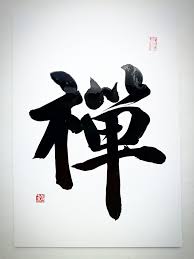
Zen calligraphy, the art of writing words in Kanji with spontaneous ink brush strokes without planning or hesitation.
Dog Zen is fast and flashy. Enlightened awareness occurs in calligraphic bursts. All you have to do is notice them. There is no systematic scheme for learning Dog Zen. It consists of what the Tibetan Buddhists called “pith instruction,” sometimes compared to nails. In plain 21st century English, hot takes. Such as:
You do not realize the awakened state, it realizes you.
Or try this refutation of the Buddhist dogma that “everything is suffering,” sarvam dukkham, and the end of suffering is the end of desire, trishna, which causes it, stated in seven words by Paco de Lucia:
You can’t be happy unless you suffer.
Where to Begin
The zigzag lightning-strike feature in the logo points to the event of satori, sudden enlightenment. The definition of enlightenment in Dog Zen is emergent lucidity. It is sudden and not otherwise, never slow and never persisting as if by the action of progressing. The mind cannot arrive by any progress at where it already is. The activity of mind is sudden and yet in a way it does persist! Traditional Zen uses the term “non-abiding” for this paradoxical condition. Common sense shows that this moment NOW is always suddenly there and yet persists even though each moment is unique and different. The suddenness of being immediately aware that you are conscious persists, but it is non-abiding — precisely because the moment NOW never lasts more than an instant.
What persists — but never abides — is the “budding” of lucidity within the normal, routine, direct, observable functions of your mind. Budh- : to bud, blossom, emerge, like a flowering lotus. When you can detect lucidity emerging in your faculty of attention (rigpa) you realize Bodhicitta (BOW-dee-CHEET-ah). The meme for this ancient word is “inceptive Bodhi.” You already have inceptve Bodhi in ordinary awareness. It is nothing more or less than your current awarenes, nothing to be gained or lost, nothing complicated or obscure. It is direct detection of how the ludicity of attention suddenly emerges at every instant you are conscious of attending — that is, attending to anything, inwardly or outwardly. The confirmation of Bodhicitta comes in a distinct sense of legerity and release, even comic relief. You release your mind to its innate enlightened state when you are not trying to figure out anything, and especially, when you no longer try to figure out how your mind works.
Among the unit lessons in this course, The Zero Preset of Mind is perhaps the optimal place to begin. Instruction in Dog Zen is not ordered by steps or levels. There are no graduated stages of enlightenment. This instruction (unique to Kali Yuga) is like a dragonfly that flits over a stream boarded by flowers. The DZ meme of “zero reset” restates the traditional Zen caution: “You cannot find your mind with your mind.” This instruction also shows up in the Ox-Herding Pictures with the analogy: “Looking for the ox you are riding.” DZ restores, simplifies, and upgrades the instructions of non-attainment Buddhism. Enlightenment is not a state comprised of god-like serenity, bliss, compassion and clarity. No, absolutely not. You cannot attain the enlightened state, but you can enjoy and express having it by contemplating how your attention, as it naturally works, already and instantaneously reveals emergent lucidity. The core technique of DZ is contemplation (dharana), not meditation. It excludes and avoids any contrived method of meditation. The flashpoints of lucid contemplation are described in the tropes, tricks, and cogent syntax of Dog Zen.
Your mind is like a dog with a bone. Sometimes, the dog brings you the bone. Sometimes, you hand the bone to the dog. It may sit at your feet and gnaw on the bone, or it may take the bone away, bury it, then dig it up again. While you engage your power of attention in full and clear awareness that you are doing so, rigpa works in one way: the dog is there. But even when you do not engage rigpa by attending deliberately to something, it works on the bones it has given you or the bones you have given it. This analogy illustrates the simple common sense dualism of mind: either you deliberately put your mind on something, or something comes to your mind on its own. Observing how this happens in the course of any ordinary day is a basic practice in Dog Zen. It is delightful and instructive. It is liberating.
I have said, pertaining to Planetary Tantra, that is the liberation of the path to liberation. The same can be said of Dog Zen. For an illustration of the self-liberating nature of mind, I know no better example than a piece of Japanese music played on the koto:
Japanese artists who play the koto, shamisen, an shakuhatchi more than often base their compositions on natural phenomena. Midare means “disorder.” (Remember that chaos is not literal disorder. It is the predictable pattern of order that allows for exceptions from the pattern to erupt. This concept is basic to modern complexity theory which is the study of emergent activity.) It describes the activity of water tumbling over rocks in a winding stream and imitates the sound it makes. You can hear how the stream begins slowly but then the current picks up at min 3:48, again at 4:35 and again at 6:15. This is exactly how one would hear the sound of the water if walking downstream following the increase of the current.
Koto music of this sort is uncannily similar to the pacing of the mind as it emerges into clear and open lucidity, one plucked note at a time. It can be said that the acoustic feeling of the five-tone oriental scale, rendered on a plucked instrument, engenders a sense of how the mind itself sounds. Even how the sound of silence sounds. This outstanding acoustic property is plangence. That is the exact word for it. It is startling, plaintive, harmoniously erratic, elusive, and chaotically precise. Such also is the activity of your mind.
The One-Note Rule
Litening to Midare and picturing yourself walking downstream beside the brook, you might imagine the last note that you hear plucked on the koto in this way: You sit on a rock by the stream with your palm upward and open, and one drop of water freed from the current falls into your hand. A single drop from the flowing stream. Listening to Midare, you hear one note at a time. That is the pristine clarify of Japanese koto music. But suppose that while this piece is playing, there is another recording of drum beats on a bongo being played in the room, the audible pulse of a ticking clock, and the rattle of a jackhammer in near-by construction. All that noise all at once in your field of hearing. You cannot hear the individual notes of the koto without hearing these other percussive sounds as the same time. Your field of hearing is jammed and cluttered by different kind of notes which, like the ticking of the clock, you only hear one at a time.
The ordinary activity of the mind combines one-at-a-time and all-at-once percussion. This is an unpleasant experience that causes many people to want to quiet the mind and supress or remove all its activity altogether. Due to this desire, many people are attracted to various forms of meditation with the goal of quieting the mind. Dog Zen entirely dispenses with meditation as a tool for this purpose. Instead, it points out a fundamental, self-evident feature of the activity of the mind: The multiple percussion effect, the jam and jitter of distracting thoughts, it simply due to not detecting to one note at a time. When you give attention to more than one, mental clatter arises. If you attend to one note at a time striking in your mind, the barrage of other notes falls away on its own. There is no need for a technique or practice to eliminate the clatter of the other notes. This is the One-Note Rule.
Mental distraction occurs when you do not catch one stroke of thought on it own. Failing to hear one note in stand-alone singularity, you end up hearing many.
Japanese koto is an excellent training tool for the One-Note-Rule. The sharp, pristine, stand-alone clarity of each note is unmistakable. Human mental activity is percussive in nature. It is quasi-acoustic because we seem to hear what’s happening in our mind even though the mind is totally silent. Thought is a soundless quasi-acoustic special effect of consciousness. Every thought process is a one-note phenomenon. Thoughts seem to run in sequence because human consciousness tracks in linear time — another special effect. But in reality, as confirmed by simple use of attention to watch how attention works, you cannot think a past or future thought, only a present passing thought — only the one note of this natural mind, this Enlightenment.
The proof of the self-liberating action of mind is self-evident. You cannot force it and do not need to struggle to attain it. You let it happen to you. All you need do is concentrate on listening to one mental impression at a time. When you set out to do this, you will immediately observe how you fail to do it. You do not need to correct that failure. All you need to do is hold the intention to register one note at a time, and the capacity to register it will increase on its own, and whatever interferes will fall away. That is the process of enlightening. Proof of your skill comes in those moments when you realize something with simple, single-toned clarity. What you realize can be anything. The content of the emergent lucidity matters less than the brilliance inherent to it. This is what the Tibetans call ye-shes, “pristine cognition.”
Lama Luv Mutt
Dog Zen is first and foremost about sanity, defined as the harmonious integration in human character of the best attributes and capacities, the moral, mental, and emotional talents of the human animal. As explained in the audio for this unit, I am not in competition with masters of Dzogchen. I am totally unqualified to spar with them on their own standards, but then again, I take the liberty to challenge their standards, premises, and assumptions about what they do. Their standards, not their first-hand experience in altered states. I have only an inkling of what they experience in altered states, and I do not claim comparable attainments, so I cannot critique them on that count. However, I do have my own experience in altered states, or non-ordinary awareness, and I would question if any Dzogchen or Buddhist master can come close to what I’ve realized through those sublime experiences.
Let it be perfectly clear, I don’t aim to refute Dzogchen. I have learned immensely from the study of that body of instruction. But I do intend to interrogate it, to challenge its goals, premises, methods, and its presumed results. Nevertheless, the mere act of questioning Buddhism in this manner may verge toward refutation, especially as some obvious objections may arise naturally regarding the issues in question. At moments, the interrogation may appear to be hostile. At others, contemptuous. My basic stance, however, is essentially comedic.
To make fun of Buddhism in all shades and schools, and ultimately to make enlightenment an occasion for fun, I use the LARPing identity of Lama Luv Mutt. Dog Zen regards enlightenment as an event in progress, not a state to be attained and retained in some sort of fabled “permanence.”
The Woke and the Woof
Dog Zen Intro (short version):
There is a longer introduction to Dog Zen, DZ 1 My Encounters with Buddhists, in the block DOGGIE TREATS (scroll down to lesson panel). There I point out that the concepts of intelligence and beauty are to the best of my knowledge almost entirely lacking in all schools of Buddhism. Dog Zen instruction on the devotional gaze of the dog — self-love looking at you — insists on the permeation of beauty in the act of beholding the world and yourself in it.
Correction in this talk: Zen is a contraction of Ch’an which is the Chinese rendering of dhyana (ध्यान), varously translated as “meditation,” “contemplation,” or “profound reflection.” It signifies steady, uninterrupted, sustained attention toward a single point, object, or concept. The method of Dog Zen is contempation, dhyana, that builds into an expontential power of concentration, dharana. No meditation required. You concentrate your power of attention (rigpa) on how your attention is working at any moment. Doing so, you contemplate
A final point: In his deconstruction of the primary Buddhist concept of anatta or anatman, Ken Wheeler (Theoria Apophasis on YT) explains that non-self does not literally mean the lack of a self; rather, what is absent or extraneous to the self. He has also mentioned the expression “the beautiful self” in Pali Sutras. I am not familiar with this material or that specific reference. I have often stated that the concepts of intelligence and beauty are absent in Buddhist discourse. If I am wrong on this omission, I welcome correction.
Whoever has thought most deeply, loves what is most alive;
Who has seen the world as it is, knows virtue.
And at last, those who turn wise will often
End up in the Beautiful.“Socrates and Alcibiades” by Friedrich Holderlin (1770 – 1843)
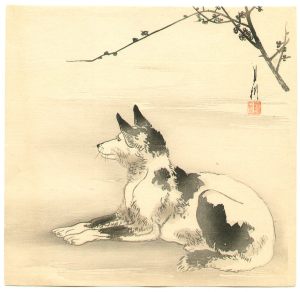
Waiting Dog by Japanese artist Ogato Gekko, c 1900
DOG ZEN and THE DRAGON FLY SUTRA: Course Curriculum
- 1 DOGGIE TREATS
- DZ | The Fracture Zone of This Enlightenment
- DZ In the Capture of the Buddha Mind
- DZ 1 My Encounters with Buddhists
- DZ 1 Ten-Minute Essay on Zen
- DZ 1 A Chat in the Jade Pavilion
- DZ 1 Featured on Nous_On_The_Loose
- Dog Zen Audio Synopses
- 2 THE DOGBOWL OF BASICS
- DZ 2 The Three Heresies of Zen
- DZ 2 Hits on Huang Po
- DZ 2 With or Without Compassion
- DZ 2 The Properties of Intelligence
- DZ 2 Tathagata and Tathagate
- DZ 2 Where is the Dog?
- DZ 2 Fake Nous
- 3 MINDING THE DOG
- DZ 3 The Light of the Mind
- DZ 3 Leading Simile: Mirror
- DZ 3 The Zero Preset of Mind
- DZ 3 The Non-Dual is Co-Presence
- DZ 3 Counting to Two (Prehensile Mind)
- DZ 3 The Machine Learning Trope
- 4 PISSING ON THE DHARMA WHEEL
- DZ 4 Blame the Management
- DZ 4 The Doggie Doo of Duality
- DZ 4 Kicking the Rusty Can
- DZ 4 The Transmission of the Lamp
- DZ 4 No Guarantee of Compassion
- DZ 4 Conversing With the Dalai Lama
- 5 LAMA LUV MUTT OFF THE LEASH
- DZ 5 Hijacking the Diamond Vehicle
- DZ 5 Sexuality and the Maitreya Challenge
- DZ 5 When A Dwarf Plays a Tuba
- DZ 5 Buddhi Call: The Right-Eye Practice with Rigpa
- DZ 5 Her Animal Power Was a Hornet
- THE DRAGON FLY SUTRA INTRO
- Dragon Fly Sutra, Original Course Landing Page
- Private: PRELUDE: The Dragonfly Sutra
- DFS Introduction
- DFS Key Instructions 1
- MAITREYA PROCESS
- DFS The Maitreya Process
- SAMPLE RECITATIONS
- DFS Demo Recitations
- THE 36 TATTVAS
- Cosmic Projection
- MEDICINE BUDDHA
- A Dose of Their Own Medicine
- THE DFS IN FULL
- The Dragonfly Sutra (Complete)
- Dragonfly Sutra Q and A