Fair Winds and A Following Sea
§ Friday 16th August 2024: First sighting of the Saturn Zil from Galicia, Spain. Witnessed by JLL, Ceridwen, and Lola.
A following sea refers to a wave direction that is similar to the heading of a waterborne vessel under way. The word “sea” in this context refers to open water wind waves. (DWW 42, Kamala Shift, 2021)
Beginning on August 14, 2024, the mothership undertakes a manoeuvre that releases her from capture to the planetary system, but she does not break formation with the system — although she is free to do so, and may do so at any time after November 2025, when this manoeuvre is fully completed. It takes a total of 15 months and moves extremely rapidly considering the vastness of the mechanisms involved.
To be exact: Assisted by Mars, Jupiter, and Saturn acting as tugboats, the mothership completes the manoeuvre by August 8, 2025, and the evidence that Alignment is successful comes to be proven in the following months into November, a four-month interval.
So, how does she do it? Quite simply, Earth co-opts the systemic dynamics of the three outermost planets to pull herself out of capture.”Systemic dynamics” means the totality of the structure and motion of those three planets: orbital tracks, north and south nodes, perihelion and aphelion points, inclination of orbital planes, retrograde cycles. In addition, the mothership uses in-board and off-board navigational orientation to find (August 2024 – August 2025) and hold (August 2025 – November 2025) the course of Alignment.
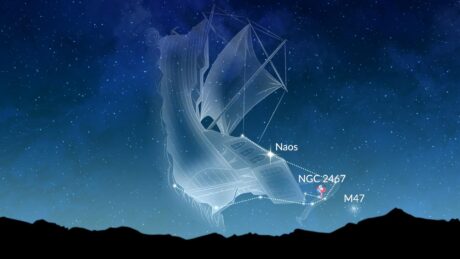
“Ghost Ship” image of mothership Earth represented as Argo Navis in the southern skies. Naos, zeta Puppis @ 139 in 19 Leo is the helm star and Canopus, alpha Carinae, @ 106 in 16 Cancer is the rudder. Note that in mid-August 2024 when release from capture begins, the Sun is @ 142 in 22 Leo, closely aligned to the helm star, Naos. The alignment of the rudder star Canopus @ 106 in 16 Cancer defines the course to be held on bearings to the other systemic and celestial features close to that alignment: perihelion of Earth, north node of Jupiter, Sirius, Nunki.
Celestial Parameters
Inboard navigation: She steers by the star Canopus, marking the rudder of the constellation of Argo Navis @ 105 19′ in 16 Cancer. However, that is not the exact course for attaining dead reckoning to Alignment. In-board navigation combines the Canopus setting with a setting to Nunki @ 282 44′ in 13 Capricorn, off-set by 3 degrees from opposite on ecliptic longitude of Canopus. This line 16 Cancer – 13 Capricorn coincides with the perihelion of the earth in 13 Cancer, close to the north node of Jupiter in 10 Cancer — “osculating elements” which converged at a distant moment in the past Alignment is completed when Jupiter reaches those points between July 20 and August 8, 2025.
In other words, Nunki-Canopus is the steerage of inboard navigation because Nunki is in the Zodiac, an ecliptic star, and Canopus is extra-ecliptic. That is a unique mechanism.
The off-board (extra-ecliptic) navigation uses the star Deneb, alpha in the constellation of Cygnus the Swan @ 335 ’40 aligned to 5 Pisces. This off-board guidance beacon is extremely crucial to the fine adjustments in her course due to the exact alignment of the perihelion of Mars @ 335. This is one of the eight systemic factors explained in a TEXT that goes with these units. It is in text format because WordPress does not allow multiple indents.
The mothership also takes a second off-board bearing from Sirius @ 104 ’25 in 15 Cancer. And it takes a third bearing from Vega 285 ’39 in 16 Capricorn close to alignment to the ecliptic star Nunki, “the proclamation of the sea.” Nunki aligns to the aphelion of Earth and the South node of Jupiter.
Triangulation by Deneb, Sirius, and Vega. Vega in Lyre at 16 Capricorn aligns to the Canopus-Nunki axis, 16 Cancer -13 Capricorn.
The Three Tugs
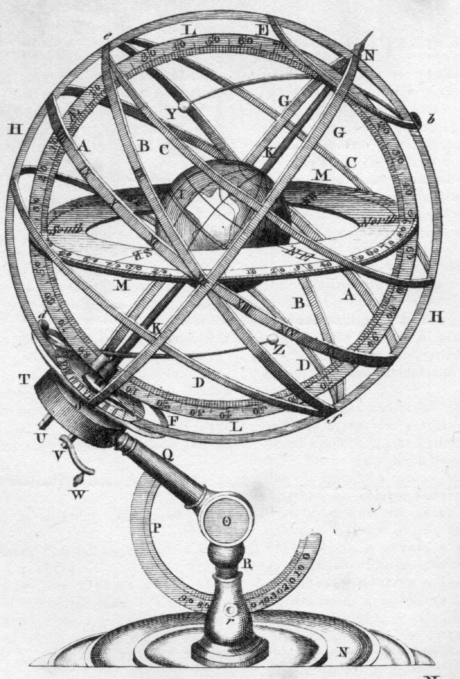 As noted above, “systemic dynamics” refers to the totality of the structure and motion of the three outer planets. There factors include orbital tracks, north and south nodes, perihelion and aphelion points, inclination of orbital planes, and retrograde cycles. All these factors are inherent to the “armillary sphere” of the solar system, the mechanism of capture. Upon release, the three-body system of Earth-Moon-Sun remains in formation with the fleet, but it can be expected that terrestrial and celestial phenomena will reveal that release has been accomplished. Although the exact square of Jupiter to Saturn occurs only once heliocentrically, in January 2025, due to retrograde cycles it happens geocentrically three times:
- 2024 August 16-23: Saturn in 17 Pisces with Jupiter at 17 Gemini ahead in the zodiacal order, rising later.
- 2025 January 2: Saturn in 15 Pisces, Jupiter R in 14 Gemini.
- 2025 June 15- 16: Saturn in 2 Aries, Jupiter in 2 Cancer (Perihelion of Saturn)
At these three moments, the tow-lines of those two tugs are taut, at other times, they are slack but still holding. You can picture this activity easily: from a line on a larger boat you tow a smaller one until the line is taut and when it slackens, the smaller boat shifts on its own to a position pre-determined by the taut line. This how the mothership co-opts the orbital forces of the outer planets for course-correction.
Mars manoeuvres here and there to nudge the mothership into precise alignment. Its initial position is exact conjunction with the large tug Jupiter at 17 Gemini on August 14th. It makes a retrograde cycle from December 8, 2024 through February 25th 2025. It passes closest to the Earth on January 15 at 26 Cancer, aligned exactly to the Celestial Anchor! Its closing position on August 8, 2025 is at 2 Libra opposite Saturn R is 2 Aries.
The role of the Saturn tug on the port line (left) is to lend orbital balance to the mothership as it rolls. The planet is in effect a huge gyroscopic wheel with vast rings. The role of Jupiter on the stern line is to moderate propulsion in the following sea and steady the stern, which in turn steadies the yaw (swerve to right or leff) of the bow. Technically, the mothership sails into a head sea, upstream against the current of the spiral arms. But the participation of Jupiter modifies this heading and adds the equivalent of a following sea. Being a gaseous giant, and the largest body in the solar system apart from the mother star, it provides the auspicious condition of “fair winds and a following sea.”
Note that both Jupiter and Saturn do not cover a long distance on the ecliptic during Alignment. Unlike Reset during the GNE, this is a fast and furious event. Jupiter starts in 17 Gemini and proceeds to 13 Cancer, a distance of 26 degrees. Saturn starts at 17 Pisces and proceeds to 2 Aries, a mere 13 degrees. Jupiter holds the tow-line to stern, and steady she goes on the following sea. Saturn holds the tow-line to port (left) toward the outer side of the galactic arm. Navigating on the head sea, the mothership would tend to sail around the bend of the galactic river, verging to starboard or west, but the Saturn tow-line corrects this action and keeps it on a straight course to alignment.
The outer three planets Mars, Jupiter, and Saturn hold the three-body system in capture, but they also assist Earth in release from capture. Thus Sophia co-opts the Archontic forces she originally put in formation. The inner two planets, Venus and Mercury, are like pilot ships that play no significant role in release from capture. However, in post-capture they have a prominent role in monitoring the course of Alignment.
Overhead View
It is easy to map the year-long manoeuvre for Alignment by picturing the solar system from above in the frame of the Rimsite. The mothership sails against the current in the third galactic arm which rotates counter-clockwise. The visualization of the mothership from above shows her sailing into the southern skies toward Canopus, the beacon star on the rudder of Argo Navis. This explains the odd notion from the GNE that the rudder is at the front of the mothership.
Looking down, port is on the left side and starboard on the right. In other words, port side is toward the external arm beyond the 3rd, and starboard is toward the galactic center. The large tug Jupiter is attached to the stern of the mothership, and the tow-line from Saturn is off to the left, port-side. This arrangement places Jupiter ahead in the sequence of the zodiac. An important detail because, due to being ahead of Saturn in the zodiac, it rises later, a condition which fits the Zil: Saturn on the meridian at 17 Pisces and Jupiter on the eastern horizon in 17 Gemini, at right angles.
Amazingly, the Zil is thus the initial set-up position for the tugs. At that moment the small tug, Mars, not attached by a tow-line, is at stern close to Jupiter: Mars 16′ 16 Gemini, Jupiter 16 ’35 Gemini in the Bull above Aldebaran.
Toward the Solar Apex at Vega @ 285 ’40 at 16 Capricorn – the direction of the fleet. Note again the uncanny recurrence of alignments. 16 Capricorn is exact with Canopus at 16 Capricorn, close to Nunki at 13 Cap, earth aphelion at 13 Cap, and Sirius at 15 Cancer.
The margin of Alignment.
Picture the mother ship assisted by three other vessels: a small tug that pushes (Mars), one large tug attached by a stern line (Jupiter), and one large tug attached to port side (Saturn). The manoeuvre begins with this precise arrangment of the Tug at first appearance of the Zil.
Systemic Dynamics: See text.
Twelve factors: north and south nodes of outer planets (2 X 3), perihelion and aphelion of outer planets (2 X 3).
Eclipses:
Lunar: September 18 in 25 Pisces at the Matangi Point
Solar: October 2 in 10 Libra at Vindemiatrix, the Grail Cup
A head sea refers to times when the direction of the waves is flowing toward the boat so that the bow is the first part of the craft that encounters the oncoming sets. Depending on the size of the waves and the size of the boat you happen to be in, it can be rather uncomfortable slamming into them one after the other as you slowly manoeuvrer through the water.
A following sea, however, is the exact opposite as your boat is moving in the same direction as the waves. And if the waves become large during these conditions, it can usher in disastrous and potentially life-threatening circumstances. A wave moving faster than your boat has the capability of overtaking it from behind, pushing your stern sideways and capsizing your boat in a split second.