8. Summary of the Parinama
Back End and Front End Faceting of the Parinama
The Six Beauties

The Bezel is Tattva 6 of the back-end faceting, Sadvidya. Through the Viewfinder/Tatta 4, but not in it, the Presence sees the beauty of the world event it projects, that which it “wills to manifest” and desires to enjoy. In Sanskrit there is a double-entendre that plays between bhoga, pleasure, and bhaga, womb, matrix. Why does the Presence perform this projection? It is immensely and perpetually addicted to it own power to produce beauty, which it longs to consume and which consumes it in turn. Addiction to its own beauty drives the cosmic projection of the Presence. The Kamakalavilasa describes this phenomenon better than any other treatise in the Sri Vidya canon (Woodroffe trans, AKA Avalon).
On right: diamond in a hexagonal bezel.
Sundarya is beauty in Sanskrit. There are twenty other words. The Presence envisions and predicates a range of six beauties through the Bezel. This happens looking “downward” to theater-side of the Parinama. Tattva ! Previsions the world event in these six beauties and imbues these attributed into everything it manifests.
You can check out the link above to the Red Book on Kamakalavilasa. Don’t get lost in the sauce. The two essential terms seen in Verse 1 are:
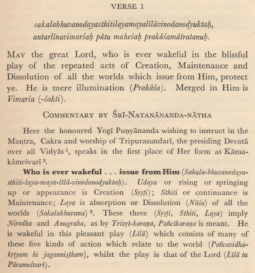
Prakasha: The Radiance of the Presence. Emergent (pra-) akasha, plasmic luminosity like sheet lightning with the substantiality of chrome.
Vimarsha: The Reflection of the Radiance of the Presence. Co-emergent (vi-) reflection or the shape of what is recognized. The PIE root of marsh to artha, thing, carries the inference of a thing in progress. Picture a photograph that emerges from a sheet of photosensitive paper immersed in developing chemicals. The photo is a thing in process. Marsh suggests shaping or molding. Suppose that you were shown frontal face images on a monitor. There is, say, a stream of 1000 images of faces that morph into each other, presenting close resemblances. One of these faces is a beloved friend. When you catch it in the stream of the 1000 faces, that is vimarsh.
When you see the face of your beloved dog in a field, or a friend in a large crowd at a train station, that is vimarsh. Kashmiri Shaivism has some excellent commentary on vimarsh, complementary to Hindu Tantra Vidya. Marsha is a philosophical concept that comes from the “Recognition” (Pratyabhijñā) philosophy introduced by Utpaladeva and Abhinavagupta, two masters in Kashmir Śaivism from around the 9th and 10th centuries.
I have read Kamakalavilasa countless times and each time found a new depth of appreciation and enjoyment. One way to read it is simply to peruse, to skim. You will find that basic terms in the exposition of the Parinama flash up here and there. The Sanskrit-language equivalents to what you learn in applied noetics are littered through the treatise like jewels in a manure heap. Dog Zen and applied noetics are like two ornamental necklaces constructed from the gems salvaged from the legacy of ancient wisdom.
What applied noetics gives you, that the treatise does not is: the opportunity for immediate, veracious, and actionable realization of how cosmic projection is ongoing and immanent in your ordinary attending to the world. Prakasha and vimarsha occur continually in the default setting of your presence in the world event. The trick is, prakasha, the abiding radiance of the Beholder, hides so that it can perpetually re-discover itself in the field of recognition, vimarsh. In Kasmiri Shavism, this act of rediscovery is called simply that, recognition.
From the origin the Presence beholds through the empty Viewfinder T4 the image of the Beloved T5 (Ishvara). To manifest what it seeks to behold in a world event, it places the percipient animal Purusha T7 in a setting Prakrita T8. Then it implements that “figure in landscape” into an event of scalar magnitude through Mahamaya T9, using four lens settings. Mahamaya invests the beauteous form of the self into all witnesses, but this does not yet confer single-self ego-awareness on the subject. Buddhic attending is self-less and absent of person. You witness without knowing or caring who you are. Rightfully, the ancient texts associate Ananda, bliss, with this experience.
To resort to the cinematic metaphor, the “figures in landscape” that emerge when the two reels run as one is like a storyboard for a script to be filmed.
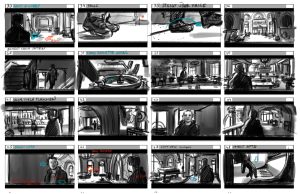
Storyboard for Blade Runner 2049 (Nicolas Rivero)
The storyboard artist frames the scenes before they are shot. His images determine or suggest how the director and cameraman will shoot each scene. The storyboard illustrations are static, like still photos.
The Skins of a Snake
Geared with the Bezel T6, Mahamaya T9 feeds the storyboard images through four settings and from there, from the body of the multi-lens midrange assembly, comes the living, sensory animation of all world events. Beyond T6/dimension 6 there is no world event comparable to what we can witness. Mahamaya has an overriding function which endows living creatures with a frame of experience, or umwelt. The kanchukas or four settings of Maya Shakti T9 are generic to the world event theater-side. They determine how it will be projected. Classically defined in this way:
Kalā: Shrinks universal authorship and limits agency
Vidyā: Shrinks universal awareness and limits knowledge
Rāga: Shrinks universal all-satisfaction and limits contentment, creating a sense of lack and bringing about desire for particular things
*Kāla: Shrinks eternity of consciousness and limits the experience of time to past, present, and future :: Maya Shakti T9
Niyati: Shrinks total freedom and all-pervasiveness and limits cause, space, and form, compels reincarnation
For shrink read: focus. Note the two Kalas distinguished by accent. Kāla (KAH-lah) is Mahamaya itself. Kalā (Kah-LAAH) is the focus of agency in a living animation. There are 17 English definitions of kanchuka. Analogic definitions are the skin of a snake, a husk, an envelope. I make the master setting of Mahamaya T9 to be identical to *Kāla and the other four are sub-settings of it. *Kāla (KAH-lah) distributes the event of animation in the linear frame of time.
It is not small coincidence that the name of the goddess Kali plays on Kala which also means dark, black, and this instant, right now. Kali’s supreme magic is the projection of nine scalar internesting dimensions of time, but only five are conceivable, and provable!, to the human mind. The normal setting is life in 4D, three dimensions of space and one of time, nunc fluens, the passing moment. You verge into the 5-dimension in the experience of phylogenetic memory or when you catch the action of shooting and projecting at the same moment. “Cosmic memory” occurs in the 5D timeframe. From there you can look toward D6 but you cannot go there in animate form. It is a level of source code you cannot access.
I have been reticent to eke out near-literal parallels between the kanchuka and camera setting such as exposure time, p0larization of light, zoom, etc. It gets a shade too precious for my taste. Please do note this however: Niyati is not a temporal setting. It determines the patterns of recurrent interactivity between percipient and setting. Repetition IRL is not subject to any temporal limitation. It is the recurrence of the same behavior or patterns of behavior one moment at a time.
Going Theater-Side
Before we go theater-side (unit 9), let’s imagine the threefold projective lens in this way: Buddhi is on boothside, Ahamkara like a focal ring aligns to the wall of the booth, Manas is the glassy lens extending to the theater-side, source of the projective beam that comes from behind the audience and situates the projection on the white screen.

Buddhists in the audience turn back, see the clear glassy disk of Manas and take it for Mind as the course of all manifestation. The Vedic yogis had a different perspective. They are on the screen, not in the audience, and from there they look out at the projective beam streaming from the slit in the wall of the booth. Using their yogic practices they go up the beam as far as dimension 5. After that, they have to fall into a catatonic state of witnessing (samadhi) to see to the higher dimensions and reach Parasamvit, the power-light-sound source.
Buddhi T14 is a granulated lens, contrasted to the bezelled lens of Tattva 6. Ahamkara sets the boundary where subjective self-awareness arises. The old commentaries all agree that Ahamkara establishes the ego or ego-centered awareness. It does so in this way: The Beholder uses Buddhi like a holographic plate of the Beloved. Any fragment of the plate will reproduce the hologram, but with less precision. Each granulation of Buddhi is like a fragment of the entire plate. The Radiance of the Presence pours through each single granular facet of Buddhi and enters the Ahamkara lens where it incurs the subjective awareness of single-self identity. In reality, the non-egoic awareness of Buddhi is always present to the ego-self. You need the ego-subject-persona to function in the social world. You do not need it to witness the world event.
You do not have to remember that you lived before
to remember that you are living now.
Each time you remember that you are living now, rather than live without having to remind yourself, you disable Ahamkara. Experience shows that in the course of each day there are moments when you don’t bother to mind who you are or how you got here. At those moments, Buddhi disables Ahamkara. You witness the world event and your presence in it without the references to a single-self subject. You can be fully aware of the world event without it, and often are!
Narcissism is the blind compulsion to re-assert and re-instate — to REIFY! — ego-centered awareness, as if you couldn’t live without it! That’s why people take selfies. You catch that you are in the presence of a Buddhically aware individual when you sense that their presence comes across to you as something more than what you know of them personally, or can ever know. It can be an uncanny sensation. Depending on how the Buddhically aware character sits in the frame of the Parinama, how deep into it their knowing goes, you can have the impression of witnessing something no longer human. That is the “prestige” of the Nagual.
Every great magic trick consists of three parts or acts. The first part is called “The Pledge.” The magician shows you something ordinary: a deck of cards, a bird or a man. He shows you this object. Perhaps he asks you to inspect it to see if it is indeed real, unaltered, normal. But of course… it probably isn’t. The second act is called “The Turn.” The magician takes the ordinary something and makes it do something extraordinary. Now you’re looking for the secret… but you won’t find it, because of course you’re not really looking. You don’t really want to know. You want to be fooled. But you wouldn’t clap yet. Because making something disappear isn’t enough; you have to bring it back. That’s why every magic trick has a third act, the hardest part, the part we call “The Prestige.”
You yourself are Buddhically aware when you know that you offer that ego-absent presence to others. The attributes of personhood are still there but they are merely laksanas, posturings. The enlightened character does not pretend not to display those attributes, for instance, acting facetiously like a sage in robes. Remember that in Kali Yuga this enlightenment is merely a game of pretenses, and whoever has the most transparent pretenses wins the game.
Fine, easy enough, right? Now let’s venture off to the theater-side.
jll 12 November 2025