The Once and Future Grail

Actorum chymicorum holmeinsium, Stockholm, 1712
Introductory talk for Course 1 Block 102 Gaian Alchemy:
Since presenting “The Course” in Santa Fe those many years ago, I have argued consistently that genuine alchemists of the tradition stretching from the Middle Ages into the Renaissance were conversant with the living entelechy of the earth, known by various names such as Dame Natura, Lady Philosophia, Sapientia, Lady Alkymia, as well as Dame Fortune associated with the “wheel of fortune” meme.
What I can say now is a resounding Yes, certainly there were some adepts of nature mysticism who conversed in a manner with the intelligence of the earth, and I can add from my own experience in such conversations that in some cases direct encounters with the Organic Light must also have occurred. However, it is difficult to assess from surviving material if and where allusions or coded references to the OL turn up in alchemical and Hermetic literature. I can attest that they are extremely rare.
But whatever the surviving evidence of encounters with the OL in the past, outside of the Gnostic Greek-Coptic material which I have extensively cited, the evidence of that sublime event in our time, right here right now, is crystal clear:
The Organic Light is the living luminosity of the planet Earth.
To encounter it is to attain the Holy Grail. This encounter is the theoria, beholding the Supernal Light in two ways: epoptia and autopsia.
To pose questions to the Organic Light is the telestic method — the divine mathesis, learning in ecstatic cognition (gnosis).
To interact with the Organic Light is the method of Planetary Tantra: interactive magic with Gaia.
The leading illustration for this unit may stand as graphic evidence that alchemists had encountered the Organic Light, pictured as the many-breasted effigy of Diana-Artemis of Ephesos.

As I noted in The Gnostic Gallery where I initially featured this image years ago on metahistory.org, concrete representations of the OL in graphic or sculptural form are extremely rare — due mainly to the difficulty in rendering a sensuous image of that phenomenon. So what’s the scoop with the line engraving of 1712? Did those who compiled the alchemical lore for that book merely include this image as a suggestive visual trope, not associating it with the vision of the OL, or did they know what they were revealing? Impossible to tell.
And so it goes through many, many volumes of alchemical lore from the earliest evidence around 350 AD coming up to late work as seen here in the plate from a book published in Sweden in 1714. Whatever the case, this depiction of the cupid-like troll working at the alchemical forge links the Great Work of alchemy to the OL, and I rest on that evidence.
The case I can make for linking alchemy and its twisted sister Hermetics to the OL goes a long way beyond that mere supposition, of course. I Block 102 of Course 1 I develop some of those ramifications. These four units are foundational to any version of Gaian Alchemy that might emerge in the present and future. Heed the grain of exposition.
Today the recognition of the presence of the Aeon Sophia within nature survives in the naive and nostalgic name of “Mother Nature.” An internet search shows this NMEME to be illustrated in a wide variety of styles. For example *lifted from tuxboard.com:

It is instructive to reflect on how the display of human female form, normally and naturally taken as an erotic sight, and in some versions intended to come across as explicitly pornographic, has perennially stood for the Earth Mother. Like it or not, the body of woman has universally been identified with the body of the earth. This trope reminds Shaktas of a basic gnostic teaching, namely, that the Aeons are gendered. Sophia is a feminine divinity at the cosmic level, additional to the obvious correlation between the earth that gives life and earthly woman who also does so.
I have chosen the title “The Once and Future Grail” for unit 1 of this Block which itself is titled THE GREAT WORK. By classical definition, Alchemy had as its goal the accomplishment of the Magnum Opus, the Great Work. To us today living as Shaktas who recognize and interact with the living presence of the Aeonic Mother embodied in the earth, the Great Work is just that engagement, the interactivity in which human animals co-create with the source of nature and of the human species itself.
The expression “once and future” recalls the book by T. H. White, The Once and Future King, a retelling of the legend of King Arthur as a “fantasy classic,” if Amazon.com can be cited. I haven’t read that book so I can’t comment on it in any way. The trope, once and future, refers to the legend of Arthur’s return. He was once king in Avalon and will be again. Thus there is a prophetic return motif embedded in the mythogen of the Arthurian matter.
As for Arthur, so it is for the Grail to whose protection he and his circle of 12 knights were dedicated. (With the twelve-spoke icon of the “Black Sun,” Himmler and other SS officers sought to recreate the protective circle of Arthurian knights in a new order or warrior class to be established as the heart and core of the racialist ideology of the Third Reich.) The Grail once seen in the Mysteries can now be seen today and in future time, future decades to the close of the Kalpa in 2216 — given that the Grailkeepers are protected by a warrior class.
§ Writing under the full moon of September 2109 in the 15th day of the shift of Shodashi, the celestial VIRGIN.
NOTE: I will not elaborate with more text and imagery in this, the first unit, of Block 102. Instead, I will use this instance to initiate the practice of putting an INTRO TALK for the entire Block into the first unit of all forthcoming blocks.
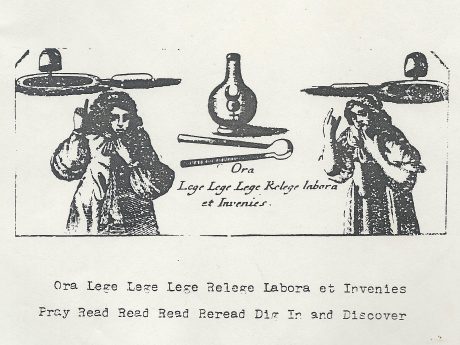
From original of “The Course,” released in 1982 in Xeroxed copies of 500-plus single-spaced typewritten pages.
Invenies in Latin means “discover,” but also implies invention, and therein inheres a key lesson about Alchemy: you work (labora) to discover what is there, operating both in nature and in the human psyche, and you continue by discovering what you yourself invent. In the Great Work, you become an originator.