Sierra de Libar
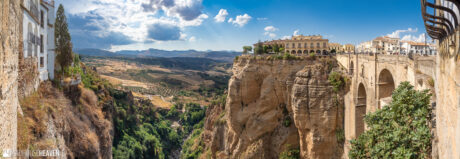
The gorge of the Tajo at Ronda, Spain, looking southwest toward the Sierra de Libar (zoom view). This is the setting of the scene in For Whom the Bell Tolls by Ernest Hemingway when partisans in the Spanish Civil War are forced to leap from the edge, a drop of 300 feet.
Sierra de Libar is part of the Serrania de Ronda, the mountainous region of southern Spain that spreads around the town of Ronda. This is in Andalucia. Technically, Sierra de Libar is the name of the lower west-facing range of the Sierra de Grazalema, a system of many distinctive peaks and ridges, but I apply it to the east-facing range stretching between the white towns Benaojan and Cortez de la Frontera, and looking directly across at the hillside town of Jimera de Libar. This stretch includes the summit of the Sierra del Palo (1400 m), Broomstick Peak— the Mountain of the Witches. This summit looms over the Cueva de la Pileta, a winding cavern decorated with 14,000-year-old paintings including one of a nubile woman archer, a Neolithic Artemis.

This bi-optic postcard view magnifies the mountain range in the distance. It shows the Sierra de Libar with the prominent summit of the Mountain of the Witches (on right). The mauve-gray color of the granite flank acquires in certain light the texture and tone of the flesh of a ripe nectarine. This is where I was looking on Monday, July 21, 2008 at 2:42 pm, the Ronda Moment.
In June 2002 I discovered a power spot near Gaucin and named it Infinity Ridge. This site provides a perfect view of the Sierra de Libar, looking northwest along the entire flank. My shamanic experiences at that locale over several years revealed how a wave of Gaian ecstasy pours over the Sierra de Libar. “When Gaia goes into high rapture, she creams visibly over the Mountain of the Witches like a woman in orgasm,” I used tell those who came up to the Ridge. This locale affords a spectacular rare display of the Organic Light in the daylight atmosphere. The orgasmic wave pours over the mountain summit like a tsunami of soft, seething cream. The nectarine texture of the light is palpable: this is not an hallucination, but a material eruption. The granite mass of the Sierra de Libar morphs into something like dense but porous velvet. I have seen the entire length of the mountain chain ripple and dance like a snake.
Libar in Spanish means “to suckle, to drink juice, taste.” Also, in an older and more formal sense, “to perform a libation, offer sacrifice.”
Sierra de Libar is also the name of a poem in the second series of Yeats conversions that I began in August 2009. The title of this sequence of 18 longish poems is Tantra Outbound. It is nearly complete as I write these words on 24 September 2009… The first series, Refuge for the Unborn, was written between October 2008 and February 2009. It consists of conversions of 42 shorter poems arranged chronologically up to Leda and the Swan (1923), which becomes “This Nirmanakaya.” The second series continues this sequence, from The Tower (1926), converted to “The Dolmen,” to The Circus Animals’ Desertion (1939), converted into “The Mahamudra Sky. Some explanatory notes are included, for these poems contain strange terms and arcane allusions that call for elucidation. Yeats wrote commentaries to his own poems which were loaded with arcane cues and personal allusions, too.
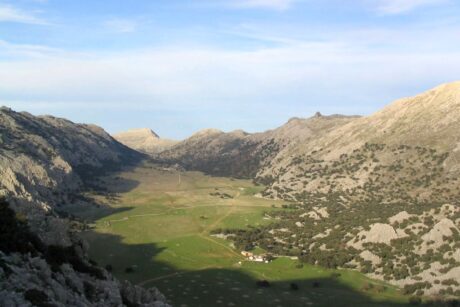
The Guadiaro Valley stretching south from Ronda, the flank of the Sierra de Libar on the right, Gibraltar in the distance. Infinity Ridge near Gaucin is located on the left where the valley converges into a V below the Sierra del Hacho, the Altar of the Vultures. It commands a view all the way up the valley.
Sierra de Libar is the third from last poem in the second series. This is a conversion of Under Ben Bulben (1938), which famously includes Yeats’ epitaph:
Cast a cold eye
On life, on death.
Horseman, pass by!
Yeats’ valedictory poem begins like this:
Swear by what the Sages spoke
Round the Mareotic Lake
That the Witch of Atlas knew,
Spoke and set the cocks a-crow.Swear by those horsemen, by those women,
Complexion and form prove superhuman,
That pale long visaged company
That airs an immortality
Completeness of their passions won:
Now they ride the wintry dawn
Where Ben Bulben sets the scene.Here’s the gist of what they mean.
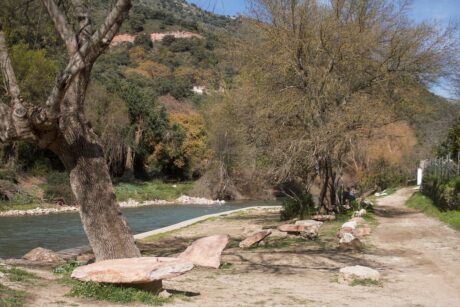
A narrow section of the Guadiaro River near Jimera de Libar at the foot of the range.
Under Ben Bulben has six irregular stanzas, each with its specific thematic elements, and a distinct idiom or style of treatment that I have more or less observed (paralleled or parodied, you could say) in the conversion. There is a small variation in stanza V, a Lashian indulgence that plays on the trope ass/class. Here is the conversion in its entirety:
Sierra de Libar
Swear by what the vultures see
Over Ronda’s circling vale,
Let this brujeria be
Finale of my mystic tale.Swear also by those stirruped stars, Dakinis
Of a jeweled complexion,
Bright-visaged company
Who dine on fate, my destiny
Completed one October day:
If anyone alive can say
That death completes, let me stay
High on the Sierra de Libar.The ash libation scattered far.
II
Nine times have I recalled my lives
But nine is not all that I have lived,
If “I” can anywhere be found
In this blur of apparent time,
Kala, the Instant Now, unbound.
No man can be complete in death
Who has not as a woman breathed,
Contrasexually for real, and felt
The slit below and unsheathed
To the earth itself, the cleft
That propagates a human error
On every man who comes bold,
Who rapes the earth, sows terror
In the womb—lest he come tender
Unto the woman he is, and hold
Her life against his own in phallic splendor.III
The vulgar world has never seen me pray,
For I bow naked, pronged and prone,
And when the moment comes to spray
I do not see myself before a throne
And certainly not on one, either.
Nor man, nor woman is the shrine,
No orchestrated rites, and neither
Of the two be taken for divine,
At least not in the way my instinct flares.
Where sexual prayers actually be laid
Is in the very act itself, and who dares
Divine that fusion rare, gets instantly remade.IV
The honest fuck is no display of love,
But offering to it, not from above
But incarnate in Eros burning there
In loins that dance a supreme care,
Not for the crib or any social ration.Desire is the measure of compassion.
Strange as it sounds, this expression
may soon enough be coming into fashion.Matisse and Bonnard left the proof
How secret art must stay aloof
From mass contamination,
And keep the carnal recreation
Pure, not perfect, never low,
But flawless in that lovely glow
A woman or a man emits
Upon the merge into what fits.No way to paint or picture it
But in the taunting hues of wit
And flesh: the intellect
At ease with lust will select
Transductive chords and
Generate into that band
Of Skydancers in splendor.
Shakti: call to surrender,
Chalice of rapture brimmed
In Tibetan blue, cloud-trimmed.The Cluster holds:
But then the dream of life just folds
And heroes vanish in the Rift,
Leaving survivors to the drift
Of broken English and mute lust.
Delusion swells only to bust.V
Gaian poets give great care
To any nuance you can spare,
Scorn not the immaturity
Of voice, and let the surety
Of memory unriven be guide
To the place where words reside
When they sink away to silence.
The sacred is without defence,
But never from this moment on
Assume it cannot be defended:
The battle that cannot be ended
Makes warrior and lover long
For refuge tender in hard times,
Dakini weather, stormy climes.With a short burst of profanity
I leave you to the Mahamudra Sky.
Last message to humanity:
You can kiss my class goodbye.VI
Under Serrania’s crest
The terton’s stylus came to rest
With not even a reckless child
To mark his transit, Kala-style.
By that way there is no cross,
No symbol of reward or loss,
No epitaph to grave on stone,
Only a challenge like this one:Steady your eye
by love and death
alike. Match the sky.
jll: 24 September 2009
Under lunar occultation of Antares, Shodashi Shift