A Terton’s Progress:
Special Report to Staff
A Terton’s Progress: Reflections at the conclusion of the Swan Deva Shift, April 6, 2019, Flanders:
Correction: slight error on timing. I was looking at data for the new moon of March. The Swan Deva shift ended on April 5th – so D1 of the Mirita shift was April 6. Otherwise, details were correct.
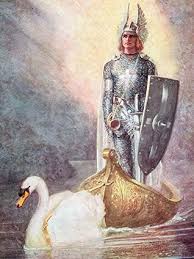
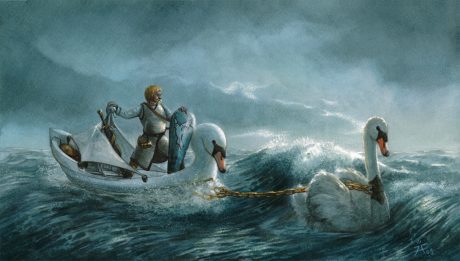
Here you see a typical romanticized version of Lohengrin, the Knight of the Swan.
(Pinterest: artist unknown)
Grail Children
This unique character and his story trace back to Parzival, completed around 1220 CE: Wolfram von Eschenbach states that Parzival has two sons, twins: Lohengrin and Kardeiz. Of the latter, nothing is known, the trail runs cold, but I suspect he may be associated with the tradition of Provençal poetry, the cult of Amor, and troubadour culture, and may appear as a figure in that historical genre. Provence was the refuge of heretics who turned against the Catholic faith. Kardeiz may be a Latin-Occitanian name composed of kar-deus, “hard-god,” suggesting “hardened against god.” As Parzival himself was: “I am angered against God,” he declares to Trevrizent in Chapter Nine, the apex of the story. If so, the name would connote the path taken by a heretic who seeks salvation in carnal love against the discarnate promises of faith that depends on love for the father god and his son, the Savior.
As for Lohengrin, he goes on an adventure that leads out of the epoch of the Parzival narrative into the future of the European nobility (explained in The Destiny of the Swan Knight, to appear in Course 3 Grail Studies). In the last chapter of Parzival, Wolfram presents a sketch of the legend of the Swan Knight later to be developed by Richard Wagner and others.
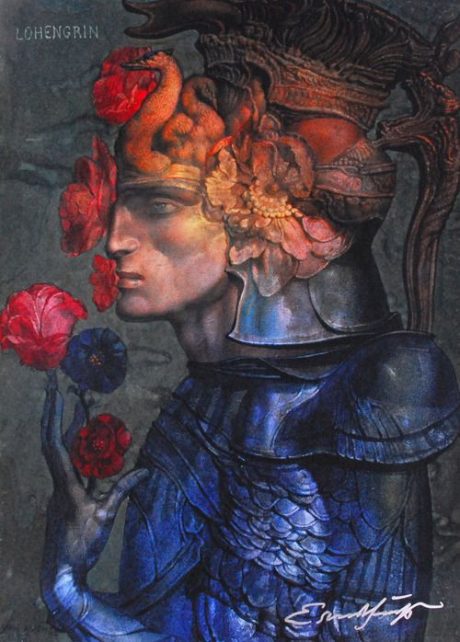
In Three Currents from the Grail I developed two of the extenuating plots that derive from the main legend, concerning Feirefiz and Lohengrin, and at the time of that writing, I left the fate of Kardeiz undetermined. Feirfiz (“proud son”) is the half-brother of Parzival, the product of the union of their father Gahmuret with a Persian woman, Belacane, Queen of Zazamanc. Here is a case of race-blending across French and Persian (Iranian) lines, but both parents are of the white racial stock. Wolfram uses the name Feirefiz Angevin to emphasize identity along the male line: Angevin was an important dynastic lineage in medieval Europe. (On left: Portrait of Lohengrin by Xenosh artist Ernst Fuchs, 1930 – 2015)
Bear in mind that Parzival’s own ancestry is half Welsh, half French: Herzelaide is a noblewomen from Wales, and his father, Gahmuret, is a free-lance knight of the Angevin lineage. I designate such unions as race-blending or interbreeding, i.e., breeding within ethnicities of the same racial stock. By contrast to outbreeding (via mother to another race), crossbreeding (via father to another race) and inbreeding (within the same race, typical of jews and arabs, e.g., close cousin marriages).
Repeating Wolfram, I have told many times the story of how Feirfiz reunites with Parzival and marries Repanse, the Grail Maiden. Together they go off to the East to the kingdom of Prester John (subject of a book by Lev Gumilev), taking the Grail with them. I have argued that the “Wish-Fulfilling Gem” that figures so prominently in Tibetan Buddhist legend and ritual practice is in fact a transmogrification of the European Grail. I stand by that correlation, more strongly than ever.
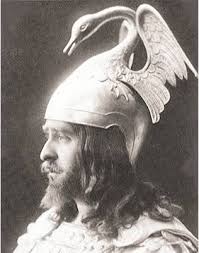 The romantic union that figures at the beginning of Parzival, Gahmuret-Belacane, as well at the one described at the end, Feirefiz-Repanse, exemplify the Vajrayana Romance or marriage of East and West, a motif associated with Swan Deva, the Storykeeper, and the constellation of the FISHES.
Left: another version of Lohengrin with the swan helmet. Source unknown.
In the closing chapter (16) of Parzival, Wolfram dangles the narrative thread of the Lohengrin legend which I have recounted in great detail. Key moments of the story occur in Belgium where local features of the landscape, such as the Dendre stream feeding into the Scheldt, matched the area where I lived for a couple of years on the domain of La Boessiere-Thiennes at Lombise, complete with a moat and deer park. The source of the Dendre was within walking distance of the domain. I had not a shekel to my name at the time. How’s that for destiny.

Main body of the L-shaped chateau seen from the public square in Lombise. Moat and deer park extend around the other side.
I am actually in Belgium now (though not at Lombise), writing these words in the last 48 hours of the Swan Deva shift. As usual in completion of a shift, there is a considerable surge of intel as well as a distinct feel of compression and distillation. I am taking the opportunity of this moment to brief you on the staff of Nemeta on my vision for the future of the school and to describe, as best I can, the current crossroad where I find myself as a free-lance terton on a life-long journey of treasure-hunting and transmission.
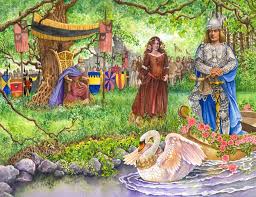
Lohengrin, Elsa of Brabant, and the swan on the Scheldt, the river that runs through central Belgium and empties into the North Sea at Anvers (Antwerpen).
#jugglingplots
Ceridwen often uses the comparison of juggling plates to describe how I manage the many-faceted content of Nemeta. Juggling plots would also fit the task. In the technical jargon of Celestics, these plots are called NIPs, narratives in play. Each narrative is a product of human imagination, and there is a finite number of the elementary or master narratives, although variations and tributary myths and legends are beyond numbering.
I don’t expect anyone to have a comprehensive overview of this array of narratives—I myself don’t, or I would say that I have at best only a tentative and ever-shifting overview. Here is a summary of the NIPs:
NARRATIVES IN PLAY
1 The master narrative: The Sophianic vision story, FGS, Fallen Goddess Scenario, the directive myth of co-creation
2 The Grail Legend: the golden seam of Sophia’s dreaming, variant of the Hero and Goddess theme, incorporates the roles of warrior, lover, mystic, and shaman
3 Anthropine Epigenesis: the myth of the origin of the human species based in the FGS but extended into the current and future epigenesis, a myth in progress: mythogen for the white races, racial humanism, the race-romantic ethos
4 The Planetary Vision Quest: the path of Sophianic Animism, variant of the Manu-Manitu theme, rite of initiation
5 The Shamanic Adventure: Gilgamesh, the quest for eternal youth and regenerative magic
6 The Autonomy Wars: the path of Chivalry and the Warrior Class
7 The Great Goddess: dimensions of the Mother Goddess in racial and regional variants, considered as distinct from the FGS
8 The Ten Avatars of Vishnu: integrated into the FGS
9 Faust: the higher striving of the white races, moral-magical challenges of the divine experiment
10 The Maitreya and BodhiMa: the education of the human races
11 The Chthonian Romance: the theme of the separation of the sexes, the Gender Rift, the prehistory of prehistory, tales of the encounters between the Gaian Sidhe, arboreal nymphs, and the hunters from Orion, the O-Men
12 The Jewish epigenesis: the myth of the chosen people, the messiah, judgement—an aberration of the theme of theocracy
13 BLACK SUN: regeneration of the originating power of the divine experiment as directed through the spectrum of races, mythogen of the Germanic peoples
NOTE: This final narrative is unique in that it has no ancient precedent. As far as I can tell, it cannot be traced back to prototypes in the inventory of comparative mythology. It is emergent since being formulated by the German author, Wilhelm Landig (1909 – 1997). Landig led the post-war movement of völkisch mysticism that preserved some elements of the ideology of the Third Reich. He revived ariosophy and the Aryan worldview. Landig coined the term Black Sun to symbolize the mystical source of the regenerative power of the Aryan races. He was active from the 1950s to the end of his life in what is characterized as “Nazi survivalism.” It is notable that the Black Sun motif emerged after the twelve-year Reich, in the wake of WWII.
FISHES and RAM
I’ve described the extent of the FISHES, with CETUS below, and emphasized how, due to the full length of that latter constellation, the head of CETUS is placed right below the constellation of the RAM. Now I want to bring your attention to the constellations of the RAM and the FISHES as they relate to the issue of guidance: considered here in the inclusive sense, individual, group, communal, national, racial guidance, extending all the way to the grandiose notion of the guidance of humanity.
The outstanding instruction: Guidance works in two ways, through narrative and through ideology.
Guidance through narratives = FISHES.
Guidance through ideology = RAM.
It’s as simple at that.
I now find myself at a crossroads in life where I straddle those two modes of guidance. Right at the moment of a new moon in 16 Aries ECL 16, in the perihelion of Jupiter in the FISHES, marking the final day of the Swan Deva shift: hence, the emphasis on narratives. The sunset crescent for the next shift appears in the RAM, signaling the oversight of Mirita: hence, the emphasis on ideology. To put it fast and easy, I find myself having to choose each and every day day if I am going to devote the precious time that remains for me to teach narratives, consistent with the zone of the FISHES, or to expound ideology, consistent with the zone of the RAM. The first option would be my responsibility based on the exceptional privilege of my life which has allowed me to achieve some mastery of comparative mythology, but the second option is currently the focus of my passion.
Needless to say, there are massive considerations involved in both of these options. The commitment required in each case is pretty hefty. And there is always the unknown factor of how much time I have to fulfill that commitment, either way.
The terton’s dilemma can be taken as an opportunity for you to reflect on your commitment to the single and unique modern Mystery School, Nemeta. Imagine what we would be doing together, gathered in the same place, if I chose to complete my life in exclusive dedication to educating you in comparative mythology. In that endeavor, I would guide you through the NIPs, direct you in investigation of those plots and themes, and improvise with you on the future dimensions of living myth. Our focus along that line of activity would be, of course, the construction of a mythogen for the white races, the work of racial humanism, based on the sacred narrative of the FGS. And what a thrill that would be.
But hold on. Consider this little twist: our studies in comparative mythology would have led us all in the same direction, namely, toward the task of constructing the mythogen for the white races, and that task cannot be undertaken without delving deep into the realm of ideology. Thus, at a certain point, the two zones merge, FISHES and RAM, guidance by narratives and guidance by ideology. So there you go: I am already at that point of convergence.
So, what is to be done? I would really enjoy teaching you how to find your way around the field of comparative mythology, how to research it efficiently without getting swamped in the material, how to detect the threads of living myth and claim them for preservation and continuing innovation and implementation in real life, and more. I would set you up in the buddy system or in small teams to tackle certain tasks, such as identification of the Sophianic figure across the entire diverse field of the mythology of all races. You would by such an exercise be privileged to enjoy many moments of delight and discovery, as I have done throughout my life. For example:
You may recall that I have pointed out that the ancient Alani of the Caucasus belong to the root stock of the ancient people who founded the Magian Order. They survive today in a rare strain in Ossetia. They are white Aryans, mother stock of the Persian peoples. When you see the head and facial structure of an Ossetian woman, that is as close as it gets to the appearance of the Magi. Look at those faces!
So, in your search for all allusions to the White Goddess/Sophia/Divine Mother in the repertoire of world mythology, you would come across this document: The Woman of the Myths: the Satanaya Cycle Source in The Annual of the Society for the Study of Caucasia 2: 3-11., 1989. Author: John Colarusso. Here is the pertinent passage:
In the myth “The Blossom of Lady Satanaya” (Hadaghat’la vol. I, 1:81) Satanaya’s love of natural beauty is portrayed as she seeks to transplant a rose before her house door. After several vain efforts she finally succeeds in having a flower grow after she has learned the life-giving qualities of water. This episode has two important and wide-spread features. First, Satanaya is linked to water, a feature important to fertility goddesses, particularly for Greek Aphrodite and her predecessors, Indo-European Dawn and some of the female figures of Old Europe. Secondly, she is credited with the discovery of water’s “life force.” This discovery is just that, a discovery. Satanaya’s “magic” is often seen as being based upon a sort of early science. Satanaya is not merely powerful and all-knowing, but she is capable of examining certain matters and divining their nature by her intelligence.
This scientific skill is evident again in the myth “Lady Satanaya and the Magic Apple” (Hadaghat’la vol. I,3.2:86-90), wherein Satanaya has “discovered” the capacity of a gold and white apple to impart immortality and everlasting youth to any who taste of it. She has not divined its properties by magic or some act of revelation, but rather by inquiry. (My italics.)
In a classroom discussion, I would leave it to you to detect and extract the themes embedded in the mythic lore and explain how they present tropes or allusions to the character and intention of the Aeonic Mother. I was particularly thrilled by this discovery due to the features I have put in italics. Until I found this treasure of world myth, I had followed the view of mythology experts such as Campbell, and Arthurian scholars such as Loomis, who asserted that the “grail question” was a motif unique to Celtic mythology. But lo and behold, there it is in this snippet of mythic narrative: Satanaya not only divines the workings of nature by her intelligence (the mind of Gaia), but she also makes herself accessible to her devotees by the exercise of inquiry, asking a question. Which is, need I remind you, the basis of the telestic method of the Mysteries.
It is no surprise, then, that certain blogs and YT channels are dedicated to demonstrating the racial unity of the Ossetian and Irish peoples! Wow.
And from there the lovely lyric fugue continues in many directions, one of which might veer at a moment toward Slavic mythology:
Mokosh is the name of a Slavic feminine divinity. It probably means moisture, derived from the same root as Slavic words mokry, ‘wet,’ and moknut(i), ‘get wet.’ It also means or suggests, “to dive deeply into something.” This goddess may have originated in the northern Finno-Ugric tribes of the Vogul, who still have the divinity called Moksha. (Which happens to be the Sanskrit word for liberation, the aim of yogic practice.)
Mokosh was one of the more popular Slavic deities and may well be considered as the great earth Mother Goddess of East Slavs and Eastern Polans. She is a wanderer and a spinner. Her consorts are probably both the god of thunder Perun and his opponent Veles, or she is possibly the consort of Veles, and might even be interpreted as another form of the polymorph god Veles himself. Their progeny are the twin siblings, Jarilo and Morana.
Again, the class puts all heads and hearts together to translate and transpose the elementary material into the frame of the master narrative, the FGS. Mokosh is cognate with the Ossetian Satanaya, and both are fertile/wet female divinities. Union (yoga) with the moist earth mother is liberation from single-self identity, immersion—a deep dive—into all that lives. Perun-Veles is the male thunder god, equivalent to Thelete : Veles-Thelete carries echoing phonemes. The offspring of Mokosh-Veles is the anthropine species of two genders, hence two siblings, Jarilo and Morana.
And the lovely lyric fugue continues, leading to this passage in a rare text:
To my delight, as I was writing this unit, I located on the Internet the PDF of a book I have been trying to find for a good many years: The Mythology of All Races, Vol. 4, 1927: Finno-Ugric, Siberian, by Uno Holmberg. Now, the Maine professor will not go into his odd craving for Finno-Urgic folk-lore—such a disclosure might take a salacious turn that recalls certain indiscrete allusions to Latina nooky during the GNE—but he does assure you of the savory flavor of this genre. The book is currently unavailable, though I have managed to purchase almost all of the 13 volumes of The Mythology of All Races, which can be found in the Ambergane Library and Archives. It is of course a standard reference for Nemeta.
… And so the lovely lyric continues, wherever you desire to take it. This is what education in comparative mythology ought to look like. For the dance that goes with the lyrics, you always turn directly to life, your immediate world, where you find the clues by wending through the warp and weft of “all your relations,” if the clues do not find you first. As they found me in Lombise, at the source of the Dendre.

The Dendre in winter. Source: https://www.flickr.com/photos/drriss/
All your rare discoveries have a precise setting in the Mother’s Dreamworld, their particular time and place.
Ideosophy
When it comes to ideology for guidance, on the other hand, things are going to play out rather differently. As far as I can see right now, it will be a more or less lonely exercise in writing, that solitary craft. Ideosophy has to be written and preserved in those hands-on artifacts called books. I will of course release some elements on Nemeta but I will only share what I deem to be appropriate “on school grounds.” Some of this ideology is highly transgressive, as you surely know by now.
ideosophy: the ideology for guidance of racial epigenesis derived exclusively from the sacred narrative of the Mysteries, the FGS.
That is the tap root, the main offshoots being racial humanism and the race-romantic ethos.
Final remarks on Mirita who oversees the upcoming shift. Mythopoetic permutations of the RAM-BODHISATTVA.
Source: Inside Santa Fe (!!??) – The Journey @alarie-tano on DeviantArt