The Pansensorial Continuum

Accurate orientation to the Cosmos begins when we place ourselves in the 4th Dimension. At first this feels a little odd, for we are normally accustomed to think of ourselves existing in three dimensions only. These are taken to be three dimensions of Space, so called. But inventing the Gaian cosmos begins with the correction: height, breadth, and depths are not autonomous dimensions of space, they are three inertial frames that belong to S-1, space enclosing, open, vacant. Additional to S-1, there is S-2, surface space or boundless topological planar extension, and S-3, space enclosed, within the surface of material bodies, the space occupied by “mass”.
Topology: the mathematical study of the properties that are preserved through deformations, twistings, and stretchings of objects. Tearing, however, is not allowed. A circle is topologically equivalent to an ellipse (into which it can be deformed by stretching) and a sphere is equivalent to an ellipsoid.
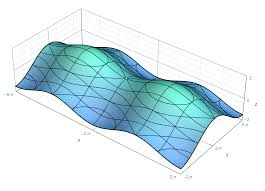 Topology of a surface area. Note that the illustration shows a “sheet” to be conceived as having two sides but no edge. The planar dimension of S-2, surface space, is intact and unbounded. As you look around you and scan the properties of the world-event, S-2 is a topological maze of shapes defined by surfaces, and you cannot go through any surface into what lies beneath it. The second common image of topography is the toroid or donut:
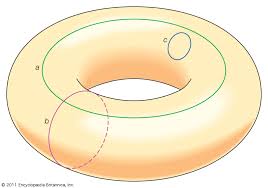
Clearly, this object has no linear boundary. You go all round it, inside and out, without encountering an edge. S-3, space enclosed, is impenetrable. You cannot access what is contained within the boundaries of S-2, space enclosing, but you can feel your way all around the planar extension of surface.
Though modern physics assures us we live in a 4-dimensional continuum, this does not help much, for it also assures us that the 4-dimensional character of this continuum is outside the range of normal experience. So-called “relativistic effects” — such as the slowing down of clocks and the shrinking of objects in the direction of motion as their mass approaches infinite — only become evident at velocities approaching the speed of light. Since no one is capable of moving at such speeds, we cannot have first-hand verification of #relativity theory. Even the verifications which have been achieved are based on data extracted from very arcane procedures. For instance, #Einstein predicted the shift of spectral colors toward red by about two parts in a million as a relativistic effect. This was in 1911 and in 1925 this shift was “proven” by #Walter Adams. Science considers this shift as “observable”: by which it means “detectable to instruments.”
But in human physics, we ourselves are the main instrument of investigation. By observing ourselves, we come to a first-hand knowledge of what spacetime really is. For this, we can rely on naive-intuitive experience: on what is immediately given by the senses. As this term “naive-intuitive experience” is rather bulky the term “pat” can be used in its place. Pat as in patent, as in speaking of patent stupidity or patent guilt: meaning plain, evident, open to direct examination. Naive-intuitive = “pat”.
As noted above, in our pat experience of spacetime we are more familiar with Space than Time. These two are given “in some kind of union”, but we really know very little about the exact nature of this melding. Seen “pat,” the different properties of Space and Time are intermingled in a confused way, so we cannot readily discern what is unique to the spatial components of the continuum, as distinct from the temporal. In the mathematical invention of spacetime, this compound error has been taken and elevated into a cardinal law, a dogma. Nevertheless, as a testing riddle this dogma can lead us into the heart of the human mystery.
The Alchemical Work involves us in a real and radical change in how we see and sense the world. So far, there are two guiding propositions to assist us in orientation to spacetime. First we know we exist in Space — though we have yet to look into how Space is composed around us. Second, we know that Time present to us, but we do not exist in it.
WE ARE PRESENT IN SPACE WITH TIME PRESENT TO US.
§ To live in 4-D means just that, stated in that simple way. The three dimensions of spatial location and the one dimension of location in time, NOW = 4-D. You live in 4-D, not 3-D which is a gimmick for special effects in movies.
Repeat: Time is present to you, but you are not present IN time the way you are IN space. You have a sense of time which appears to operate in three modalities at once: time passed, time passing = NOW, the present moment, and time coming, ahead, “time to come.” A little reflection shows that your sense of time is subjective and often vague by contrast to your apprehension of space of the three types, which is vivid and concrete at all moments.
Before investigating the sense of time, let’s concentrate on what happens in 3-D space. Doing so, attention goes to the realm of the senses.
For this, the approach is pan-sensual: following the given actions of all the senses. According to some systems of esoterics, there are 13 senses or more, but here only the conventional five need be considered: hearing, sight, touch, taste, smell. In the sensory plenum of spacetime, these are the media of consciousness. Each sense is a precise and comprehensive medium for translating events in the continuum into consciousness. Thus, whatever exists in consciousness, in the mind, also exists as raw data in the senses. To go from sense-contents to mind-concepts is the pan-sensual approach.
Take the five senses in this order:
HEARING / SIGHT / SMELL / TASTE / TOUCH
What do we notice about them, just in the way they ordinarily operate? And how, specifically, are they designed into the form of the Human? Well, all but touch have their corresponding organs located in the head. Eyes for sight, ears for hearing, nose for smell and tongue for taste. The organ for touch is the skin, distributed all over the body. Touch is not localized in the head.
Another feature of the senses relative to their organs: the triad of taste, smell and hearing works through organs formed by holes or cavities. Though the eyes are set in cavities, they are not themselves cavities, as are nostrils, ears and the mouth. As for touch, the skin is perforated by tiny cavities, pores, but does not itself consist of a cavity. For the moment let us simply take note of these points, for future reference. They illustrate specific design-features of the human form, pointing to cosmic processes to be considered as we proceed.
For our present purposes, we are concerned with those design-features of the senses which give clues to the general design of D-4. Taking the triad of smell-taste-touch, we note that these senses all involve direct contact with materiality. To touch and taste something requires unmediated contact. Taste is almost an act of ingestion, and often in touch something rubs off. So there is always transference or transmutation of matter involved when these senses are operating. Smell is borderline, for it does not require direct physical proximity yet it does involve an ingestion of material particles through the nose. In fact, this is a more intense and complete ingestion that tasting. You can taste something by merely touching it with the tongue, in which case some particles are chemically processed by the taste buds. When we inbreathe matter in the act of smelling a more intense, more interior action occurs.
In summary, this triad corresponds to materiality. From the sense-given data we arrive at an abstract and comprehensive concept: matter. This is certainly one of the general design features of D-4, the presence of matter! But what about sight and hearing? According to materialistic thinking, such as pervades modern science, these too involve contact with material particles, for light is composed of particles called #photons which are material, though their mass is #infinitesimal. Also hearing requires contact between the eardrums and the air-vibrations which are also material.
This materialistic treatment violates the pan-sensual approach and misleads us from the cosmological info given in the sense-data. Materialistically considered, there may be contact in hearing and sight, but formally there is none. These are not contact-senses like the other three. In fact their essential character consists in lending the quality of detachment to consciousness. These two senses in tandem participate most intensively and formally in the process we call thinking. We both see and hear our thoughts, as attested by such common phrases as “I see what you mean” and “I don’t hear you” among others. Normally we do not smell, taste or touch our thoughts.
While smell, taste and touch are contact-senses, sight and hearing are concept-senses.
What else can be observed about their character that might lead over to the identification of a general phenomenon? Well, sight is unique in its relation to light. It requires light, as none of the others do. Perhaps this correlation to light is adequate, for light is certainly a general phenomenon of the observable and experienceable continuum.
This leaves hearing. We note that the ears are unique among the head-located organs in that they open in opposite directions. Here is a beautiful instance of how the pan-sensual approach befits the genuine human physics. For the formal arrangement of the ear-openings in opposite directions points to cosmological design-features of profound significance. It shows how the ears and the sense of hearing working through them are indifferent to spatial location, or at least the most indifferent of all the senses. Hearing is peripheral to a spherical extent. You can hear what is above your head or behind it. Sight is only peripheral to a little over 180-degrees of the body-field, at best.
Another unique feature of hearing is the way it operates within the range of sense-detectable impressions. To show how this is so, we can adopt the data of science to the pan-sensual approach. Science informs us that the speed of sound waves is 1,125 feet per second, or about 768 miles per hour. You can see something moving at this rate and even travel in it. Contrast this with the #velocity of light-waves, 186,000 miles per second. Thus sight, the other concept-sense, translated data from a realm beyond direct, pat-sense-detection, while hearing is “homey”, remaining within the realm of normal experience.
As for the three contact-senses, they likewise translate data arising from events in which we cannot directly participate. In smell and taste there is a transference of materiality we cannot witness, usually, for the #particles transferred are minute. We cannot see into our nostrils where the olfactory function is working, nor can we see the chemical action of the taste-buds in our mouth. As for touch, this involves contact with internal mass and mass is also invisible. You cannot know if a metal ball is hollow or solid except through hefting it. You can know from watching it behave when dropped but only through mental inference, not direct observation, pat sensation.
Thus of all the five senses, hearing operates within close-range, translating data from familiar and detectable events. Even though the contact-senses bring us formally into close-range to materiality, we cannot witness the specific events of transference and ingestion they involve. And sight, the other concept-sense, is the most paradoxical and obscure of them all, for though it renders all things visible it remains itself invisible. It is remote, in contrast to hearing which is homey, close-to-home.
By now it may be evident how these “naive” observations in the pan-sensual attitude can direct us to the inherent design-features of the Cosmos. By comparing and contrasting the senses, we learn to see the design-features built into them, which in turn point us to the design-features built into the universe as a whole.
Now, to what do our observations about hearing lead? What general phenomenon, or “main event,” in the continuum is indicated by the observable design-feature of this sense? We have noticed that the arrangement of the ears shows hearing to be indifferent to special location, to a large degree. In short, hearing is largely omni-directional, even though its range is relatively limited. What other general feature of the continuum do we experience as omni-directional? Space itself, obviously. Thus, by its indifference to spatial location, hearing directs us to Space as the “main event” to which it is formally and structurally correlated.
Thus, from the sense-givens we derive definite “field-concepts” descriptive of all events within the continuum. And putting these together with the senses we get this ensemble:
HEARING : space
SIGHT : light, observation: You can watch time pass.
SMELL TASTE TOUCH : materiality
Once this basic set-up is established, the totality of manifest phenomena in our continuum can be summarized in these three concepts: Space – Light – Materiality. Materiality, including everything from peas to planets, equates with motion, for all matter is in motion. Motion is meaningless without something that moves. Again, a little thought will confirm that motion cannot be formally correlated to either of the other two general phenomena, according to how they are given in naive-intuitive experience. Motion occurs in Space but Space itself is apparently a motionless void.
As for light, who knows? Does it move or don’t it move?
Time is tentatively omitted here, due to its subjective and dubious nature, which remains to be considered in the lessons that follow in Part Two of The Course.
§ Summary: As a human creature you find yourself located IN space of three frames with time present TO you in one primary and immediate modality, the present moment NOW, and two elusive or phantom modalities, time passed and time to come. The 4-D world event is a continuum or plenum of sensations coming through the media of the five senses — hence, the pansensorial continuum. With these adaptations of language in effect, the sterile concept of “the four-dimensional continuum” comes alive and throbs with sensation.