PROST: A Reading by the Author
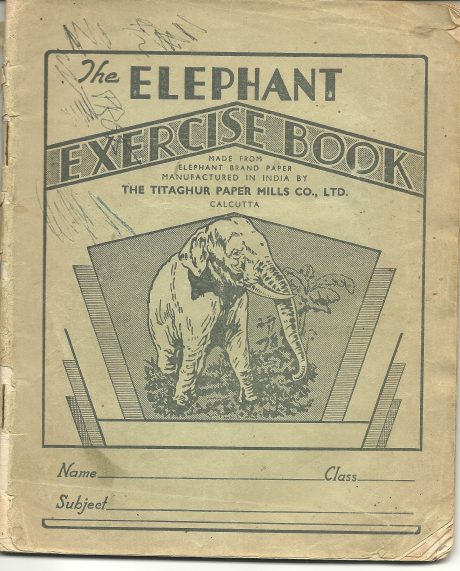
Goddess knows how, I had the money to fly from Katmandu to Pokhara and return. I did so in the clear realization that I was too weak to make the trip on foot as many travelers of that time did. Following the healing by the lake and several other miraculous events, I wrote the story in one uninterrupted session.
Prost Audio:
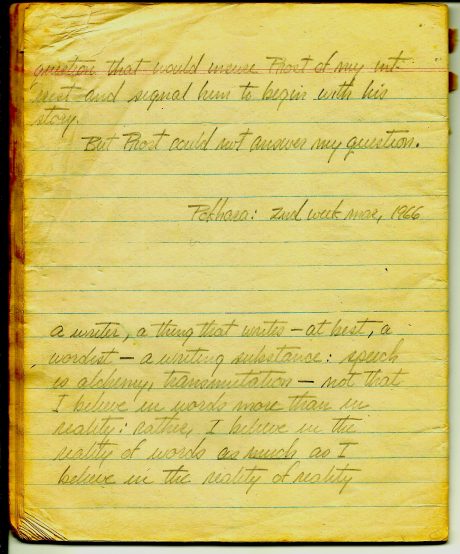

First and last pages images shown.
I only wrote on one side of each page except for the last page where, oddly enough, I wrote on both sides, so that the writing came to fill the book to the last line.
The word I was looking for in the lead-in to reading the story was of course becalmed. There is an obvious clue to that condition known to sailors in the carvings on the large wooden door that Prost scrutinizes.
Nevertheless, ye lost and leaden hours, I will rail at ye while life lasts.
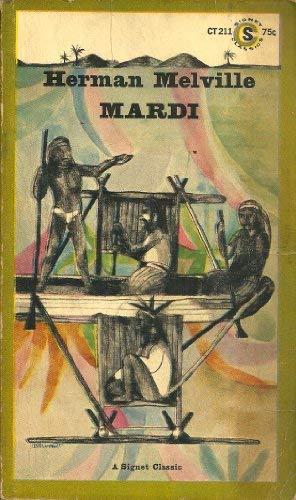
On left: The cover of the Signet classics edition of Mardi which I carried for many years. It rests today in the Ambergane library. Having discovered it with such delight during my brief stint at the University of Maine in Orono, I did not realize it would play a role in the dream fugue of novels through which the Aeon Sophia acquires the “tread” to go lucid in her planetary dreaming and eventually crack into human NLP.
I read novels quite voraciously, but selectively, until about 1980 or so when I abruptly stopped. Slowly it dawned on me that the novel genre had an expiration date. Once it served its purpose, it faded out. Monumental works to which I gave my full attention over many years, such as Ulysses by James Joyce and Journey to the End of the Night by Louis-ferdinand Celine, may be compared to massive dolmens standing in the road that represents the progression of the novel genre from its beginnings around 1750. These works set an end limit for novelistic writing such that no one could equal them or surpass them, just as no one has been able to match Moby Dick. I know of course that novels are still being written today but they are mere exercises in narcissistic indulgence. I would mark the final, formal end of genuine novel-writing in the sunset phenomenon of renegade genius John Gardner who wrote an excellent book called On Moral Fiction. Gardner had the last word on what a novel should be and do.
Prost is of course “Oh so very Borges,” someone might remark. Surely it is. But I did not know Borges at the time except perhaps in passing conversation with Richard Lair with whom I traveled in Malaya, Thailand, Cambodia, Laos and later India. I first delved into Borges when I returned to the USA after 1967.
Jorge Francisco Isidoro Luis Borges Acevedo (24 August 1899 – 14 June 1986) was an Argentine short-story writer, essayist, poet and translator, and a key figure in Spanish-language and universal literature. His best-known books, Ficciones (Fictions) and El Aleph (The Aleph), published in the 1940s, are compilations of short stories interconnected by common themes, including dreams, labyrinths, philosophy, libraries, mirrors, fictional writers, and mythology. Borges’ works have contributed to philosophical literature and the fantasy genre, and have been considered by some critics to mark the beginning of the magic realist movement in 20th century Latin American literature.
Borges (Roughly Bore-haze, more correctly Bor (g/k) – HAY) has Saturn (social mission) in the SNAKETAMER ECL 259, exact position of my Mercury. I would identify the driving motif behind his magical realism as the quest theme displayed in that Constellation. Of course, Castaneda is a direct literary heir of Borges.
In some weird and wonderful manner, due to how I was being handled, I was hovering between the worlds of Melville, Borges, and Herman Hesse when I wrote Prost. The tale that intersects with this one about writing Prost concerns my meeting with Ahasuerus, the Wandering Jew, in Kathmandu, who placed in my hands a copy of Hesse’s Journey to the East.
The Grail Question
Something that may strike you about this story is the twist in the final line. In those years I did not have the Parzival legend engraved on my mind, as I do now, and consequently, I was not savvy on the very great fact stated by Arthurian scholar Robert Sherman Loomis:
The strange employment of the question as a test for the hero to pass and as a means toward the healing of the Fisher King and the restoration of the land [occurs in] no instance outside the Grail romances.
– Arthurian Tradition and Chretien de Troyes, Octagon Books, New York 1982, p. 382
All experts agree on this unparalleled singularity of this motif: the Grail Question. Elsewhere Loomis asserts “Here, then, in Ireland and Ireland alone, do we find the motif of a country laid under a spell which can be lifted only by the asking of a question” (The Grail – From Celtic Myth of Christian Symbol, Princeton University Press, 1963, p. 54). Most remarkable, then, that the question motif establishes down the opening and closing notes of Prost, no? And rather weird — but perhaps not, considering my state of mind at the time — that the motif is inverted. In Parzival, the hero fails to ask the question upon his first visit to the Grail castle. In Prost, the main character fails to answer the question posed by the one who wants to hear his story.
In different versions of Parzival, the Grail question appears in two forms: the colloquial or mundane form, “Uncle, what ails thee?” and the formal or chivalric form, which is rather ambiguous, “Whom does it serve?” In my Redice interview on the Grail and the KWP, I propose a third form, which might be called existential: “Who did that to you?” I came to that expression when I realized that the full power of the unparalleled motif of the Grail question only hits you when you see that the narrative does not provide an answer to it. No version of the legend presents the wounded Fisher king giving an answer! The entire plot pivots on the posing of the question.
With this elaboration you can see how the Grail question was embedded in the syntax of Prost, without my knowing it was. Today I can happily say that both the question and the answer are confidently known to the Company of the Grail living here and now. In my synopsis of Wolfram’s Parzival, I reveal how Amfortas the Grail king must have answered the question by explaining how he received his wound. This account does not come in a straightforward way in the narration; you have to tease it out.
White Privilege
Writing Prost by candlelight in that unfinished building, I did not anticipate the end of any one sentence when I began it. I did not have the contour of the story in mind before writing it down. I did not think it out, I did not know where it was going. It came like dictation. And lo and behold, it ended on that exact emphasis: asking a question.
Today I encourage everyone in PT to know both the Grail Question in its three forms, as well as the answer, the story of how the patriarchal hero came to be wounded. I assure you that the plot structure of Parzival is unlike any other story in the world, from any culture, in any time. Contemplate that structure, based on the three conditions. The more you review and revisit the story, the more amazing it looks. And keep the theme of the Grail question uppermost in your mind. Doing so, you can savor your privilege. White privilege. Again, I can assure you that every expert who has written on the Grail in the past, or any living today, if such there be, is unable to respond as you do to this tale, due to not knowing that the motif of the Grail question points directly to the method of the Mysteries: telestic initiation, instruction by the Light. It is your privilege to know that.