1. Gaian Alchemy

The subject of alchemy is close to my heart and has been the “strange attractor” for many wonderful discoveries throughout my life. My mystical quest began at the age of four with a terrifying lucid dream, but my investigation and extrapolation of the “Great Work” began around eleven when I encountered the word alchemy for the first time in an adult comic strip illustrating Fermi’s experiment at the stadium in Chicago. The text declared that he discovered and re-enacted the secret art of alchemy, the transmutation of matter. I knew at that moment, without knowing how I knew it, that the splitting of the atom had nothing to do with alchemy. I knew that something was fundamentally wrong in the science that would make such a claim, and so I set out to find out what alchemy was really about.
Fortunately, I had ideal conditions to begin that quest due to the enchanting natural beauty of coastal Maine where I grew up from the age of three. As early as four, I wandered alone in the pine woods along the coastline. I smelled the iodine that burst into my nostrils when I stomped on the bubbles of seaweed on the ledges of the coves. And then, in the fall, a spectacular display of alchemy caught my attention.
Near Friendship, there was a dirt road called the Finntown Road. It ran through the woods between to local paved routes. At the beginning of September each year, the leaves of the deciduous trees would start to turn, producing a staggering array of colors. The interval of this spectacle was brief and quite precise. I remember that it often ended abruptly on October 10th when a wind came and blew away the dried leaves. They gathered ankle-deep on the road, still retaining their colors for a week or so before turning brown. I can hear the sound of walking over them as I write these words.
More than once on the Finntown Road and elsewhere among the deciduous groves, I would stop and gaze, barely able to move. Often there would be a barn or small deserted wooden shed nearby, adorned with a huge stand of purple lilacs. The fragrance was sublime. Immersed in it, I gazed at the panorama of colored leaves in ecstasy. In one spot there was a small pond that reflected the palette of exquisite colors. I gazed at the water in wonderment. It looked like metal or enamel rippled with vivid hues. I could not work my mind around to escape the impression that the surface of the pond was not merely water reflecting the trees: the colors had transmuted into a sheet of alchemical metal.
Years later, I wrote a paper on the alchemical metals and the planets. It was one of my first published articles. The twelve Courses of Nemeta lead off with Gaian Alchemy. Now you know why.
Lady Alchymia
In the perspective of so many years since 1982 in Santa Fe, I hold strongly to the view that my writings on the Great Work present a unique contribution that establishes a primary truth:
The operations of the human psyche (sensation, cognition, memory, imagination) are events in the terrestrial habitat to be considered as real and palpable as the extra-human processes of nature.
What you feel and think about the wind on your face is an event of nature, exactly like the wind on your face. To me that says it all.
Nemeta Course 1 on Gaian Alchemy is dedicated to a subject at the heart of Planetary Tantra, and linked intimately to Sophianic Animism and Grail Studies. Among the varied components of the Sophianic vision that I have attempted to formulate and deliver in my life since the Terma in August 2008, this one stands perhaps above all others: human co-operation with the dreaming power of the Earth. That is, of course, the working premise of PT, “interactive magic with Gaia,” so defined in October 2008. It is likewise the working premise of alchemy in the Gaian perspective.

Lady Alkymia, colored version of a medieval woodcut. She was also called Sapientia, Lady Philosophy (Boethius, The Consolation of Philosophy), and other names.
“The Course” is the name I gave at the time to an experimental study dedicated to the new science of eco-psychology. It includes a secondary text on the novel iteration of astrology I was practicing and teaching at the time — “terrastrology.” It runs to 545 single-spaced typewritten spaces. I relied heavily on alchemical material I found in the works of C. G. Jung, as I had no way to access source materials. (At the time, I accepted Jung’s famous Lapis-Christ parallel, but later demolished it.) The Course has 21 chapters divided into three sections, Space, Time, Matter and Sensation. For the latter, I used a citation from Wilhelm Reich: “Sensation is the greatest mystery of natural science.”
Inner Space
Looking back on that time, I still recall the satisfaction I derived from tackling a particular mystery of human consciousness. Sensation comes from the external field of nature, but other operations of consciousness such as memory and imagination arise within the psyche, in “inner space.” But where, pray tell, is inner space? Jungian psychology nagged at me due to the way it described events in the psyche without ever explaining where they actually occurred. To resolve this problem, I determined that the conventional model of 3-D space was wrong — or, at the very least, it was inadequate for alchemical purposes. I proposed that the so-called “three dimensions of space” are merely inertial frames of measure of one dimension of space which I called S-1, space enclosing. More specifically, they are frames of measure of the space that surrounds and encloses anything: height, depth, width.

So much for S-1, shown here enclosing the apple and table. I designated S-2 as surface space. Clearly, this is a dimension of space distinct from S-1. An apple on a table are two objects in S-1, but the surfaces of the table and the skin of the apple belong to S-2. That is the second dimension of space. Then there is S-3, space enclosed. The mass of the apple within its skin is distinct from the bounding surface of the skin and again distinct from the space enclosing it. I observed that the mysterious property of S-3 is that you can’t get into it. If you slice the apple you get another variation of S-2, another surface, but you do not access the mass of the apple.
I dedicated several lessons in The Course to support my theory that S-3 is “inner space.” That is where psychic processes occur and the alchemists knew it to be so. Due to the religious prestige of scientism, few people know that so-called physicists do not have a clear concept of mass and ultimately cannot define what it is. They rely on a mathematical cipher. Inner space, S-3 is the dimension where transmutation occurs. What happens within the mass of material bodies is as great a mystery of science as sensation. To this day, I consider this proposition to be one of the more stunning innovative features of The Course.
The Enigma of Mass
By the way, you might be baffled by my assertion that you cannot get into S-3, inner space or the space of mass. The answer is simple: you cannot get into inner space because you are in it. Your physical body moves freely in S-1, space enclosing composed of three inertial frames (height, depth, width), and your skin is an example of S-2, surface space. All that is immediately obvious and verifiable. When it comes to S-3, you encounter a profound enigma. If you cut into the human body, you will find that although you penetrate inside the skin, you still encounter surfaces only — the surfaces of internal organs, for example.
At the time I was teaching The Course, I still had some astonishing discoveries to make about the enigma of “inner space.” The completion of that investigation can be found in the exposition of the Parinama, the mechanism of cosmic projection. It involves the inversion of the Vedic proposition that the cosmos emerges by increasing densification of matter. According to this view, we live physically in a realm of “gross matter” that somehow emerges from a primordial state of pure consciousness without material substance.
But Gaian Alchemy denies this proposition and rejects the theory that pure immaterial consciousness exists at all. “Everything is material” is the third proposition of Mayavada Vedanta in my idiosyncratic makeover of the dual metaphysics of Vedic doctrine. In that paradigm, I contend that everything material and physical in the cosmos emerges from a state of infinite density that conceals itself in states of lesser density. Maya is the mechanism of this self-concealing or self-masking action. The ground-state of infinite density is called Mula-Prakriti, “root substance.” And it is a substance infinitely more hard and dense than anything conceivable. The alchemists called it the Alkahest and Universal Solvent. Defined: “universal solvent sought by alchemists,” 1640s, from French alcahest, from Medieval Latin alcahest, a pseudo-Arabic word coined by Paracelsus.
To conceive of this substance, imagine that everything material dissolves into a more dense medium, not a less dense one. That is my inversion of the Vedic formula of cosmic emergence. I have explained in various places how I arrived by direct experience at this astonishing claim. Remember that the Organic Light — the Philosopher’s Stone or White Stone — exhibits ” infinite density and zero mass.” The density of the Stone is indeed stone-like, yet it is inconceivably harder than any stone or mineral. It possesses zero mass because it is buoyant. Everything material floats in it. Science fails to comprehend what “mass” is because it does not detect this element of buoyancy.
To complete this argument: You cannot get into mass because you are in it, permeated by it, floating. I contend that mass is a great mystery of natural science on a par with sensation. ‘Nuff said.
The Great Work
The Course contains dozens of illustrations which I Xeroxed and pasted into the lessons distributed to a group of 35 students. It presented almost a hundred classical terms and motifs from original sources, such at the Green Lion Eating the Sun (image of photosynthesis), the Tree of Planetary Metals (the five sensory fields of the human animal), the elixir, Mercurius, Melusina, the Philosopher’s Stone, and many more. I ran the Course on Monday evenings over 40 weeks from October 4, 1982 to July 4, 1983.
I also drew extensively on Paracelsus who I considered to be my mentor or mascot in the project. Like other alchemists before him, Paracelsus wrote in German and “dog Latin” and introduced many neologisms such as Aquaster (star water) and Iliaster (star matter) which I attempted to translate into new language for the operations of Gaian Alchemy. I cited his assertion that “The Human is more than the planets.” Meaning that the human effect in the cosmos, grounded in the terrestrial habitat, exceeds the effect of all the other planets.
The studies in Course 1 here show how that guiding premise emerged years before I defined Planetary Tantra as such, and how it has morphed and matured in the ensuing years. In the legacy of medieval and Renaissance alchemy, I found in Latin (thanks to the works of C. G. Jung) two signal propositions:
Tam ethice quam physice, “as much moral as physical,” and this one:
Nature performeth her operations gradually; and indeed I would have thee do the same: let thy imagination be guided wholly by nature. And observe according to nature, through whom the substances regenerate themselves in the bowels of the earth. And imagine this with true and not with fantastic imagination.
– Artis Auriferae, “The Art of Goldmaking” (Compiled 1610 AD)
Somewhere in the hard copy of “The Course” I have the original Latin for the latter citation. The operative syntax is: imagine this with true and not with fantastic imagination. The operative word is invenio. This is Latin for “I find, I discover.” Invenio occurs practically as a kind of command prompt,
c:\invenio/transmutation
When you come to realize that discovery is invention, specifically, genuine sense-based discovery along the lines of the Great Work, you are on to the NPU (Non Plus Ultra) and you know with the confidence of a Gnostic that originality is the only game in town. The biosphere is a laboratory, the Hermetic vessel of alchemical transmutation. The primary instrument for transmutation the artifex. This is a psycho-sensory tool unique to the human animal. The artifex combines and co-ordinates the power of imagination with descriptive power (the NPU, Non Plus Ultra), and through these two capacities the Great Work is accomplished.
According to the instructions of the Chinese tradition of alchemy, which I also explored and tested, the Great Work is completed in the Autumn! I used Hexagram 42, Completion, from the I Ching to support my concept that the human effect on nature achieved through the artifex increases the beauty and complexity of nature.
Conversion to Nemeta
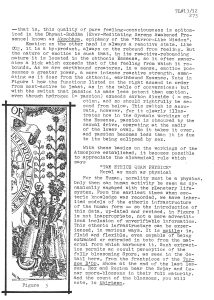
Sample page from The Course on the Toison D’or and the up-graded thirteen-chakra system of the human body.
After completing the original presentation of 40 lessons, I revised The Course and reduced it to 21 lessons, cutting out the astrological sections which I compiled into another text specific to that topic. That was a considerable act of revision.
Upon setting up Nemeta.org in 2018, I had the grandiose intention to revise that material once again and convert it into unit/lessons for this Course. This proved to be an impossible task. Obviously, the curriculum of Gaian Alchemy today would require extensive reworking, condensation, cutting and in some areas amplification to produce the reprise. It would entirely eliminate certain passages and interpretations. I would rip out all of the pervasive religious tropes and Christocentric material, such as the Lapis-Christ Parallel (noted above). From the earliest surviving records, alchemy was corrupted this association. Paracelsus himself exhibits Christian tropes and gestures of piety, although I suspect he did so for cover. Jolande Jacobi’s edited compilation of his work is extremely dubious and misleading on that tendentious issue.
Walter Scott translated the Hermetica in four volumes (Shambhala Publishing) with interfacing Greek and Latin texts. In the introduction of volume I, he says explicitly, “There is no Christ in the Hermetica.” I would echo, “There is no Christ in Gaian Alchemy.” But it abounds with the presence of Sophia, and the provable evidence of that presence.
It turns out that almost no material from The Course has (yet) found its way into the block and unit/lessons here. Whether it can be done, or it worth doing, I cannot say. I leave you with a final guiding meme in Latin:
Festina lente. “Make haste slowly.”

The alchemist and his sorora mystica at work
1 Gaian Alchemy: Course Curriculum
- § HIGHLIGHTS AND PREVIEWS
- 1 PAM’s Sensorium
- Breathing With the World Mother
- 1 The Gaia-Sapiens Exchange: A Proto-Terma
- § 101 TOWARD A FUTURE ALCHEMY
- 1.101 Toward a Future Alchemy
- 1.101 Psyche in its Habitat
- 1.101 Atmospheric Physics
- 1.101 Art and Artifex
- § 1.102 THE GREAT WORK
- 1.102 The Great Work Revised
- 1.102 Hermetics and Handover
- 1.102 Alchemy Without Christ
- THE COURSE PART 1
- 1 The Riddle of SpaceTime
- 2 Topography of the 4th Dimension
- TL 3 The Human Stance
- Private: TL 4 Formation of the Stone
- Private: TL 6 Grammatical Design of SpaceTime