Discovering the Wisdom Goddess
| There is no unit panel for this Course landing page SOPHIA. The intention of this page is to frame the mythological figure of the Wisdom Goddess in contemporary terms. Commentaries on the FGS can be found in the Vocations / The FGS Legacy Version (link below) and on Course 2 Sophianic Cosmology. FGS 1.18 has a unit panel with all 18 episodes to be selectively released.
FGS Legacy Version in 9 Episodes The Final Iteration: FGS 1.18 |
Everyone who finds this screen is likely to come with here the same question in mind, no matter how it is formulated and even if it is not clearly defined:
How do I get to know about the Wisdom Goddess of the Mysteries, Sophia?
Good question there, but first consider this distinction: You can desire to know about Sophia, or you can desire to know the living presence of Sophia. What is your intention? Either way, this landing page (in open source access) can direct you to how to discover the Wisdom Goddess.
Pronounce it So-FI-ah, rhymes with desire. The adjective, Sophianic, can be pronounced So-FI-anic or in the softer form, So-FEE-anic. So-FEE-ah is a common name for a woman in many cultures. Around the world in 2026 it is the most popular name chosen for a newborn female.
In the first place, you can know about Sophia by consulting her story, the biography of the living planet, the Fallen Goddess Scenario. That is the sacred narrative recovered and restored by the Maine Professor JLL over many years of research, investigation, and experimentation. JLL is not the originator of that narrative. He derives it from a range of ancient sources — mainly, the Nag Hammadi Codices in Greek-Coptic idiom, as well as passages from the Christian ideologues (such as Irenaeus) who hated the Gnostic teachers and their heretical message, slandered them, and attempted to refute them, but, nevertheless, who did in some cases report accurately what they taught. Is that clear?
The Strawman Argument
It is likely that most people who come to the Gnostic material wanting to learn about Sophia will be influenced by the strawman argument against the Gnostic message to humanity. You are advised to preview the 20-minute talk on the John Lamb Lash YT channel titled: The Missing Debate Over Gnosticism
This talk explains how you are likely to have been disinformed about the power and presence of Sophia due to a negative spin on the Gnostics sources. The strawman argument against the Gnostics is widely adopted for several reasons. It supports the popular claim that humans are fallen sparks of divinity trapped in a prison/planet matrix. This is an erroneous distortion of the Gnostic message about your divine mother, the Aeon Sophia. It claims that she sinned against the Originator, source of all the Aeons, and consequently produced an alien monster who then created the material world. This narrative is the source of the “prison planet/matrix/simulation” meme widely promoted by David Icke, Zechariah Sitchin any many others. This victim narrative misleads many people into assuming that the Gnostics regarded this world of human experience in the terrestrial habitat to be the production of a Satanic entity, the Demiurge. Nemeta carries a wealth of supplementary material on the sacred narrative making it absolutely clear that the natural world you inhabit is not a prison planet matrix, nor it is a simulation of any sort. You would do well to clear your head of those assumptions so that you can begin to learn about Sophia.
Background learning:
Against Simulation:
Living in An Altered State:
Planetary Animal Mother
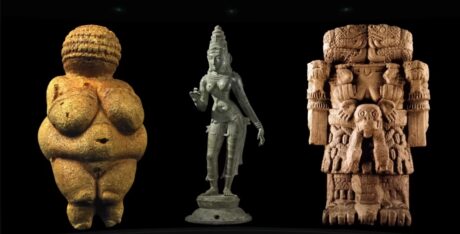
Three types of visualization of the planetary animal mother, PAM.
One of the mysteries of human existence, perhaps the topmost, concerns the question of how humans living in different places around the world knew they were living on a planet before anyone saw the photograph of Earth allegedly taken from outer space. The evidential reality of living on Earth is the same for everyone and always has been. You only see that region of the planet encompassed by the horizon. If you travel, you see different settings but they are all likewise enclosed within the visible horizon. This happens also if you are far out at sea, when you see a huge circle of water in all directions. Call that the visible terrain, from terra, Earth. It is as if you were observing a small circular area on the back of an elephant. You do not see the entire animal but you might infer that it is there in some way.
Now, what if natives of the mother planet with no conception of it being a spherical body floating in space somehow inferred or visualized its totality? How would they do that? Studies in anthropology and indigenous cultures show that they did so in a consistent manner, although with many variations. Look at the three images above. They present three types of visualization of the entire planetary body.
The first type, on the left, is the Venus of Willendorf. It is typical of hundreds of extremely old sculptures and figurines of the Great Goddess. She appears to be obese and pregnant at the same time. Why is she represented in this way? Native peoples who could not see the entire planet, as we cannot, inferred that this was how she would look if you could see her body in its complete form. The inference was not stupid. Two intuitive factors informed this visualization: first, the entire planetary mass is a maternal body, and second, it is the source of all that lives. Scholars use the French term largesse to describe the sculptural properties of the Venus of Willendorf and other similar figurines. It means, large in form and attributes, abundant, oversized. They assume that this sculptural representation refers to fecundity, and it does, but not to that alone. The Great Mother produces and reproduces everything that lives from material largesse. Native people perceived and conceived the non-human world animistically, on the default setting of human intelligence. They knew that all nature is alive and they visualized the source and ground of aliveness in such figures. There is nothing stupid or superstitious about that way of picturing Mother Earth.
The second type, in the middle, occurs in hundreds of thousands of images and sculptures. You don’t have to ponder this figure a long time to realize that it was conceived and created by people who regarded the mother planet as a voluptuous woman who commands respect by her beauty and elegance. Well, PAM is a voluptuous woman. Nature is all-around beautiful, sensuously endowed, and elegant in her designs which you immediately notice in the patterns of all natural creatures as well as in their patterns of behavior. Native peoples responded animistically to the beauty of these patterns even though they had no ideas about them, no empirical syntax for them, no concepts or words to describe them.
Objection: The fact that they pictured PAM, who is not human, in human form makes the visualisation questionable or open to critical rejection. Some people (many, probably) would argue that anthropomorphism — non-human phenomena in human form — is a falsification or fabrication. Attributing human form or attributes to something that is not human is unacceptable to many minds.
Intrapsychic Projection
But hold on. Rather than argue intellectually against that objection, I pose this question: What if the non-human living presence in nature — the baseline reality of animism — projects itself into human imagination in that way? What if it reveals itself in ways conformable to our capacity to see it? Representations of the second type, including a vast range of male and female deities, are called epiphanies, from epi-, beyond, and phaenein, to appear. The definition is clear and blood simple: what is beyond the immediate range of appearances observed by the mind and captured by the senses can make itself known by a figure in our imagination. How else would it able to show itself to us, if not in the guise of something we know and recognize?
The third type, on the right, belongs to those representations of the Great Mother that occur in non-ordinary awareness, such as shamanic trance. In some cases, this visualization can be terrifying, really scary. In ayahuasca rituals, PAM often reveals herself in the form of an immense snake. This is not an hallucination to be dismissed as a mere figment of human imagination. It is what Terence McKenna called a “true hallucination,” distinguished, for instance, from the pink elephants someone might see in delerium tremens due to alcohol poisoning. The reasons why PAM might present an epiphany as gruesome and terrifying as the “Serpent -Skirted Goddess” (Coatlique, koh-at-LEEK-cue-A) are technical, and to present them here would be a digression. Suffice it to say, PAM can deploy such fearful epiphanies to ward people away from her presence, due to her perception that they are unprepared to receive her presence.
Whatever notions you may have already about a supreme goddess figure, Mother Earth, the Magna Mater, or the “Divine Feminine,” it is normal and natural for you to wonder how to picture that supernatural entity. How do you see her in your imagination? Valid question, there, but the question is rather misleading. You do not have to picture the Wisdom Goddess in your imagination, because you can perceive her directly as this short video.
Here is another montage with the same narration.
Listen closely and make sure that you comprehend what you hear. In the life you have, which you call your own, you are actually a character in the living dream of Sophia. Her life story is not over, nor is the conclusion of it pre-determined by higher, superhuman powers. You have a role in the outcome. Register that.
Picture and Presence
As you learn about Sophia, it is normal and natural to wonder how to picture her, as just noted. But consider this: To picture her form imaginatively is one thing, and to encounter her presence immediately is another. You do not need to picture her to encounter her presence. It is what you apprehend directly all the time when you behold nature, the matrix of all life in the biosphere. You contact it through all your senses, sight, hearing, taste, touch, and smell. Sophia reaches you directly through the full spectrum of sensorial consciousness. The natural world is totally real, alive, animated and animating. It is not a simulation or a prison-like matrix. What you see in nature from the dirt to the skies is her planetary body.
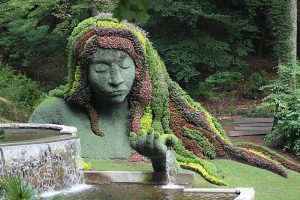
All that being so, there is however an abiding need to know how Sophia looks imaginatively. The caption of the image at the top of this screen reads:
As the focal point of the Cascades Garden, this 25 ft sculpture truly was the highlight of Imaginary Worlds. Created by Mosaïcultures Internationales de Montréal, Earth Goddess, with her flowing locks and out-held hand spilling with water, became part of the Garden’s permanent collection. During the holidays, her hair shines bright as she becomes Ice Goddess.
This is a statement from a website braidedway.org with the title “Rediscovering Sophia – The Goddess in Christianity.” This site is a propaganda platform for Christian indoctrination that intends to spin Sophia and her story away from its Gnostic origins. This attempt to incorporate the Wisdom Goddess into Christian faith is, at best, an error, and at worst, a distortion of her identity and power. The caveat above warns you about falling for the strawman argument against the Gnostics and their message to humanity. Likewise, religious propaganda of this kind misinforms you about the Wisdom Goddess and leads you away from her presence. There is no reconciliation between Gnostic wisdom and Christian faith. Do not be conned by that pitch. Sophia is the supreme goddess figure of pagans and heretics. Christian, Jewish, and Islamic versions of her are fakes that subvert and betray your innate experience of her presence. Sophia does not need Christian religious dogma to reach you and teach you about the divine experiment where you are placed, witness to her presence and witnessed by it.
I presented this 40-minute talk as if I was addressing people who know nothing about the Sophianic narrative and the way of life framed in it.
The Shakti Cluster
Let’s return for the moment to that question of how to picture Sophia. It is an open-ended opportunity. Get BASED and ground yourself in the immediate awareness of her presence in nature, AS nature. Then you can go on to picture her in whatever way you like, according to how the act of imagination suits you and pleases you. You can picture her as a tree where you go to relax and reflect on life, or as an animal such as a lion or mother bear, a wolf, a snake, a dragonfly. These are all epiphanies of the Great Goddess. They are like omens she uses to signal you to her presence, but, of course no single one of them encompasses the magnitude of her presence.
The Sophianic material on Nemeta interfaces with Planetary Tantra, originally defined (in 2008) as “interactive magic with Gaia.” Take note that “magic” in this context does not mean fantasy, make-believe, or new age pretending. Magic is simply the action of magnification. When you interact with Gaia-Sophia, the dynamic that you engage magnifies your capacity to experience life exponentially. It amplifies your talents, expands your intelligence, and even transforms your ordinary consciousness into a portal to the Supernatural. Sophia is both natural in her status of Mother Nature, and in another way she is supernatural. By Gnostic definition, the Supernatural is the wellspring and source of nature. It is not above or beyond nature, it is within it, permeating it. The living evidence of permeation comes to your awareness in a single factor: Beauty.
As noted above, this item on the menu of Nemeta links and interfaces primarily with two other places in the School: Course 2 Sophianic Cosmology and the FGS Legacy Version in Vocations. It also interfaces with Course 1 Gaian Alchemy, Course 6. Living Myth, and Course 10 Mythophrenia. These courses are like peripherals or accessories to the fundamental material on Sophia. Finally, or perhaps first of all, Planetary Tantra is the practice for knowing Sophia, beyond merely knowing about Sophia. It uses an iconic model or mandala of unique design features, the Shakti Cluster:
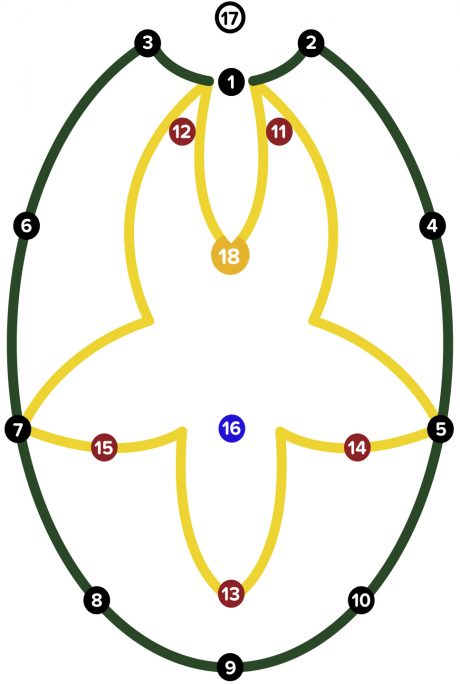
So, am I proposing that you use this design to picture Sophia? Yes, that is correct, but with the imperative point of guidance: This is not how Sophia looks sensorially or imaginatively — needless to say. It is a schematic layout of the telluric force field of the mother planet. Like a circuit-board. Consider it to be the full-ensemble of energies in the biosphere, if you like, although I advise avoiding the words energy or energies. Frequences is better. Not frequencies, frequences. Frequence rhymes with sequence. There are a total of 18 frequences in the SC which all operate concurrently, and yet they also come on and off with special effect, or high-range shift, in a sequence.
In PT, you can learn to recognize the specific frequence running at high range by following the cycles of the Moon. Each month when the thin crescent of the new moon appears in the West after sunset, it signals that one specific frequency is operating at high range for the duration of that month. This sequence follows the order of the starry constellations and you can track it in the background of the heavens….
All right, then. This is a lot to introduce in this landing page. If you go to Visitors you will find open source material on the practice of Planetary Tantra, the Shakti Cluster, the lunar cycles and the Zodiacal frame of the frequences.
jll: December 22, 2025 – June 21 2026 (“dog day”)